Issue 43: Welcome to the Jungle

Another week zips past, and another three articles for the Music Jungle!

The Olympic item is a song from Lincoln Music Service.  I’ve also written about creating stories to go with the pieces that children are learning, to help them perform them better. I notice, on re-reading the article, that i have referred to the examples as “Grade” pieces. This might imply that I am only concerned with exam pieces; not so; it is just to give an indication of the level of the music I was thinking of. Finally, I have written about some lessons that I have taught recently out of doors. The samba lesson was this week, on one of the drier days; the djembe lessons were back in May, before all the rain came.

Posted in The Jungle | Leave a comment

Issue 43: Olympic Song “We live and learn”

https://www.lincsmusicservice.org/olympics-2012/

The Lincoln Music Service seems to have had a great time with their Olympic music project, creating their song “We live and learn”.  I came across the website by googling “Olympic music”.

The website has all the downloads you need to access the song; lyrics, lead sheets, backing tracks and even karaoke music videos.


Posted in Olympics | Tagged , | Leave a comment

Issue 43: The story in the music

I find it can transform a performance if the player has some idea of the context and content of the piece of music. It is usually fairly easy for a beginner to interpret music from the romantic or modern periods. The title is often a Big Clue (Sad Dance, Reverie, Chinese Take-it-away). Baroque and classical pieces often make no sense at all to the younger children; sonatina, bourree, minuet do not supply any useful hints to the uninitiated. It is often helpful to describe the clothes that were worn, or find a picture from the period.

I always try and create some kind of story from the music.

A grade 1 “Andante” can become the soundtrack to a walk in the country side, with the phrases describing various incidents: opening phrase – arriving at the car park; rising scale – climbing a hill; modulation to the minor key – starting to rain; descending scale – making your way back; return to major key – remembering there is a packet of chocolate in the car.

Even at higher grades, students often seem to have no idea of how to “story-board” a piece, and the result can be like being machine-gunned by three pages of semiquavers, or listening to a long and boring poetry recital in a strange language – in other words just a barrage of meaningless noise. A grade 6 Vivaldi or Teleman “Allegro” is entirely transformed once it has become, say, a trip to a Paris fashion show (a fifteen-year-old, clothes conscious violinist); opening section – the tickets arrive, you learn that you have been chosen to go; second section (modulation through all sorts of keys) packing, choosing clothes, can’t decide what to take; return to the tune of the beginning section – setting off, getting closer and closer to Paris; Coda – arriving outside the show, getting off the coach and going inside. Now the piece makes sense to the young player, and therefore has some shape and sense of narrative in performance.

Posted in Lessons that have happened, Listening Music, Practising, The organised teacher | Leave a comment

Issue 43: Music lessons out-of-doors

On several days so far this term I have been able to teach music out of doors.

I think my favourite lessons have been have been the djembe lessons held in the “wildlife area”. It was a bit of a kerfuffle taking the djembes and chairs out from the classroom and across the playground, but well worth it. We sat round in a circle in the long grass, by the pond. It was a warm, but over cast day, so the sun wasn’t too hot or bright, and played through all the djembe pieces we knew, including the class’ own djembe composition.

The acoustic out of doors is so very different to when we are all in the classroom; much drier, less intense. The younger children (year 3) found it quite difficult to adapt and keep together – a point worth bearing in mind if you are planning an out-door performance. The older children (year), after an initial descent into chaos, got the hang of playing out doors and were much better at maintaining the pulse and holding everything together.

It just seemed the perfect way to celebrate all the hard work over the previous terms – intensely satisfying to reach a point where we could all just go and enjoy the weather and the drumming in an east-going, companionable atmosphere.

Samba lessons have been happening in the playground as well; the class has been divided into two bands, each lead by one of the children. For the first session, both bands played the same rhythm while the leaders practised starting, stopping and signalling breaks. However the bands each have their own samba, so it is impossible for both bands to be in the hall at the same time. The outside acoustic came as a total shock; once again it took a little while for the children to get used to the sound and to learn to keep together, but they have risen to the challenge. Last week, the hall was unavailable, so the bands assembled at opposite ends of the playground. I wondered if they would be distracted by each other, but this didn’t seem to be a problem. Whether any of the neighbours were distracted is another question!


Posted in Lessons that have happened | Tagged | Leave a comment

Issue 42: Welcome to the Jungle

Half term! Where did it all go? I spent good deal of it watching the Jubilee celebrations. There was a feast of music too; one of the high spots for me was seeing the brilliant visuals for the Madness song at The Concert, and another was the service at St Paul’s the next day.

Now half term is over… and I am wrenching my thoughts towards the coming weeks; Olympics, music exams and end-of-term concerts are liable to feature in the next few Jungles.

This week, there are articles on coping with rhythm when sight-reading, the concert possibilities of Rolf Harris’ song “Sun Arise”, and an Olympic activity called “Synchronised Swimming“. There you go!

Posted in Uncategorized | Leave a comment

Issue 42: Help With Sight-Reading – Keeping the Pulse and Rhythm

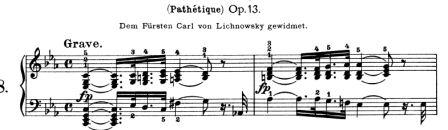
I discovered early on – probably at about Grade 2 – that I couldn’t actually cope with counting numbers out loud “1 and 2 and 3 and 4 and ” while trying to read and play handfuls of notes. I intuitively developed a method of going “der der der der” in my head as I played, with the “der” sounds being at the smallest notes value that I needed to deal with, usually quavers. Now that I am a grown-up, I realise that what I was doing was “sub-dividing the beat”. A good example of this technique at its most extreme is when I used it for getting the rhythm EXACTLY correct in the first movement of Beethoven’s Pathetique Sonata;

Thinking in demi-semiquavers (8 x “der” to one crotchet), and starting each new crotchet beat on a new line to try and make it nearly possible to see what I am on about, the first bar, in my head, would go something like this, playing the actual notes on the bold syllables;

DER–der–der–der-Der-der–der–der–

Der-der–der–DER-DER–der–der–DER

DER–der–der–der-Der-der–der–der

DER–der–der–der-(Der-der–der–der)

I’m not teaching at the level when it is likely or reasonable that my students should be faced with sight-reading at this level. So here is something rather simpler;

You may prefer to use French ta- and ta-fa times, or the usual “1-e-and-a- 2-e-and-a-“. Because I can’t count, and don’t have much brain-space left for complicated thinking when I am sight-reading, I would designate “DER” to be semiquavers, and go;

DER der der der DER DER DER DER

DER der der der DER DER DER DER

DER DER DER der DER der DER der

DER der DER der DER der DER der

It works for me – and it may work for your pupils. Dotted and syncopated rhythms become easy to play – just allow the right number of “ders” for the note value you are wrestling with.

Posted in Sight Reading | Tagged , , , | Leave a comment

Issue 42: Adventures with my New Guitar

Having accidentally bought a new guitar some months ago, I have been trying to justify the expense by using it a much as possible in lessons.

I am delighted to discover that one of my favourite songs, “Sun Arise”, made famous by Rolf Harris and his wobble board, is a “three-chorder”. All the printed versions that have come my way are in F major, a key that I avoid like – listening to –  Schoenberg (sorry – it just needs too much concentration and at the moment I’m more into “easy-listening). Actually, F major is a doddle on the ukulele; C, C7, G, F and Bflat chords being among the easiest to get your fingers round, but that’s another story.

If I shift Sun Arise down into D major, it’s an easier key for me to sing, and I only need D, A and G.

I am going to teach the song to the all the children at the small village school I work in as one of the items in our big  end-of-term music assembly. The plan is that a couple of the other teachers will join me in playing the guitar (and any children who learn guitar outside school), and we will add violin, woodwind, recorder, drum, clave  (pairs of sticks) and any other parts that seem a good idea. Triangles on the word sun. I have got a plastic didgeridoo which might come in handy if anyone can play it.

A few minutes on Google will get you the lyrics and chords. I’m not too sure about the copyright situation with this song, which is why I am not publishing the links here. (You can find it in the ACBlack Music Express series for Year 2 if you have access to it). If you have got the sheet music and want to play it in D, substitute D for the first chord, d A for the second chord, and G for whatever they use as the third chord somewhere in the middle of the song.

You can watch various YouTube videos of Rolf Harris, and also Alice Cooper, performing the song. I think we’ll be going for the Rolf Harris version, and save the heavy metal rendition for another occasion.


Posted in Guitar, Songs, The organised teacher, Ukulele, Uncategorized | Tagged | 2 Comments

Issue 42: Olympic Activity; Synchronised Swimming

This is a bit of a golden oldie, but none the worse for that.

Working in pairs, the children mirror each other’s movements; child 1 is the leader, and child 2 is the “mirror”.

So, whatever child 1 does, child 2 mirrors it exactly. It is easier to demonstrate than to explain, so I suggest that you show the children what you want them to do, rather than waste too much time explaining.

Swap over the roles from time to time, and also pause a few times to let the children talk about the activity; what kind of movements work best? Why? What skills are they using? If you spot a pair doing something different, or innovative, or working exceptionally well together, ask them to show their work to the class.

Once they have all tried leading and being the mirror several times, bring out the instruments. Give both children in the pair the same instrument, and try the same activity but now playng their instruments as well. At this stage, some reminders about being careful, watching what they are doing, keeping their distance from other pairs. is probably a really good idea.

It may be easier to start with everyone sitting facing each other in pairs to start with before adding movement. Again, pause a few times so that you can discuss the activity and showcase anything of interest. At the end you may be able to video and watch the children’s work, and let them comment on what is effective, and what needs re-thinking.

I tried this activity in a year 3 djembe Wider Opportunities class. We set the djembes down on their sides on the floor and sat on them, like riding a leg-less horse, facing each other. I watched while the children worked with good focus and concentration, incorporating different sounds, and rhythms and varying the dynamics and tempo with increasing complexity.

Posted in Composition, Djembe, Lessons that have happened, Olympics, The organised teacher | Tagged , , , , , | Leave a comment