Issue 121: Year 1 and 2 back on track

I have been having difficulties with a rather large year 1 and 2 class. There are a lot of reasons for this – several children have “issues”, one is “statemented” with their own TA to watch over them, several are very, very young, several are very, very, shall we say “mature”? “Too cool for skool” already? Add to that the class is scheduled for late in the day, late in the week, and you can begin to see the problems.

The first lesson of term was pretty hard going, with the children “phasing” in and out of staying with the activity. There was a fair bit of “twirling around” instead of “super-sitting”, and chatting, and losing attention.

to see the elephants...The second lesson was – you choose from the words “busy”, “active”, “full of sound” “noisy” “chaotic”. Any, all of them, would fit. We are doing “timbre” as the topic, and I brought in a large selection of instruments for everyone to explore. We all had a good time, and everyone played everything, but on the whole I needed to rethink.

I came to the conclusion that the children were really not in a place for anything too demanding, requiring lengthy listening to discussion or explanations, sharing, taking turns, waiting – at least, not yet.

So, last week, I went right back to basics. We did an action song, first sitting, then standing. You can hear it, and see it, being signed here; “Come Dance With Me” http://www.youtube.com/watch?v=OqEW8SW-3GQ (I have access through the singup.org magazines and CDs that I carefully saved – this is from issue 4).

Then another song “The Song of the Fish”, sung and signed here:   http://www.youtube.com/watch?v=Ec2rpOPrLHA (from the same singup magazine).

We did some moving-to-music; “Fossils” from Carnival of the Animals”, running on the spot every time we heard the opening theme.

To calm down, we sat down and “listened” to a story; “Nellie the Elephant” from my CD set “Hello Children Everywhere”.

It worked like a charm. The children were mostly engaged all the way through, there were no behaviour issues and a good time was had by all. I covered the “timbre” element in the “Fossils” activity, and the lesson included singing, moving and listening.

This week, a repeated the winning formula, adding body percussion sounds to the “Song of the Fish”, changing the “moving” music, and choosing “The Ugly Duckling” as the story (“hands up if you heard the man whistling at the end of the song” -that covered timbre).

I might, just might, bring in instruments for the “Song of the Fish” next week. Maybe. Or perhaps the week after!

branch

Posted in Class Teaching, Lessons that have happened | Tagged , | Leave a comment

Issue 121: Ted talk; “The Transformative Power of Classical Music”

many thanks to the Kodaly and Orff Music teacher’s blog

http://herdingcatsgeorge.blogspot.co.uk/2013/12/the-transformative-power-of-music-ben.html

for this link:

http://www.youtube.com/watch?v=r9LCwI5iErE

topiary piano

which is a “TED talk” by Benjamin Zander. It is twenty minutes long – and well worth watching every minute. I was inspired by his “explanation” of a Chopin Prelude, and also by his definition of success; that it should be measured by “how many shining eyes do we have around us?”, and finally moved by last story he told us, about the importance of everything that you say to everybody around you.


I hope I have tantalised you enough to persuade you to sit down and take the time to watch!

branch


Posted in The organised teacher | Tagged | Leave a comment

Issue 120: Welcome to The Jungle


And I’ve managed to get this week’s posts up for The Jungle!

Here we go – ideas for helping violinists to play in tune, or pianists to work out which finger is which, a weird and wonderful way of bringing order into a chaotic class (well, it worked for me), and how elephants, hippos and kangaroos solved the horrid intricacies of coordinating right and left hands in a Grade 2 piano Sonatina.

Have a great week…

Kangaroo

Posted in The Jungle | Leave a comment

Issue 120: Stickers for a young violinist


Tonight I was running through the piano accompaniments for a young (and very tired) violinist preparing for Grade 3. One piece has a couple of Grade 1 standard A major and D major arpeggios, and she was consistently playing them as minors, failing to place her second finger correctly.

We were getting nowhere, merely repeating the same horrible intonation over and over again… until I stuck a little sticker on the offending second finger. It happened to have a picture of a smiling monkey on it.

This had the effect of making it possible for her to identify WHICH finger needed to be corrected, as she could identify it by the feel of the sticker on her skin.

Once she was consistently playing major instead of minor arpeggios, we could move on. She’s stuck the sticker by the side of the first arpeggio as a reminder…. next week will prove how effective the smiling monkey has been.

Knowing which finger is which is a major problem to young and old beginners. I used to scratch my fingers, or bite them when I was practising (not hard enough to draw blood, I should say) when I was trying to remember a certain fingering or correct an ingrained mistake.

Kangaroo

Posted in Lessons that might have happened, Piano, Practising | Tagged , | Leave a comment

Issue 120: Ten Seconds of Stillness


Here’s another weird thing that is working well at the moment; challenging an extremely chatty, fidgety, distracted, noisy, class of year 3 and 4 children (aged 7 and 8 years old) to stand absolutely still for ten seconds.

I didn’t make them do this as a punishment, but as a challenge, and to my surprise, they stood stock still, motionless, without speech, for the ten seconds. I think that the children were as impressed as I was! Before they had a chance to move, I catapulted them back into the song that we had been failing to teach them for the previous ten minutes, which they now sang with focus and commitment and a good sound.

I tried this again today; half the class had arrived in the hall a full fifteen minutes before the lesson was due to begin, and, as usual started, to racket around the empty space. I got them organised (with the help of my samba whistle which I discovered that I still had round my neck from earlier in the day) and set them the challenge of standing stock still while the other half of the class came chuntering in.

The new arrivals were both impressed and baffled, and I was able to start the class from a point of silent focus rather than fighting to catch their attention in order to begin. It was altogether a much better lesson than previous weeks.

Kangaroo

Posted in Class Teaching, The organised teacher | Tagged , | Leave a comment

Issue 120: Elephants and kangaroos – the tricky bits

No, nothing to do with “Carnival of the Animals”, but that’s probably why I chose these animals to teach some tricky moments in a Grade 2 piano piece.

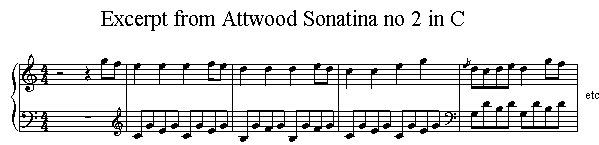
The problems started in bar 3 and continued into bar 4:

Exceprt from Attwood Sonatina in C

In bar 3, she couldn’t coordinate the two right-hand crotchet Cs with the left hand, playing C E instead of C C. That meant that the second half of the bar was doomed. In bar 4, the combination of the grace-note and the left hand change of position was causing a complete brain malfunction, and all rhythm, fingering and note accuracy was scattered to the winds.

So, we started with the first problem; the two right hand Cs and the matching left hand quavers. I called this section “Elephant” (I have no idea why) and we worked on learning to play just that little bit. When that was secure, we moved on to the next two beats, which I called “Hippo” (what is happening in my subconscious? Probably better not to think about it). Anyway, the “huge problem bar” was transformed into simply playing “Elephant” and then “Hippo”, which for some reason appeared to be much easier than playing the notes on the stave.

I labelled bar 4 “Kangaroo”, because it “jumps”, firstly with the grace note hopping in before the beat, and secondly with the left hand leaping into the bass clef. This simplified itself into “play the grace note while you move your left hand, and then plonk the RH pointy-finger onto D and LH pinky onto G at the same time”. Easier to do it than to say it.

Once we had done this in slow motion a couple of times, she was able to start at the beginning, deal with “Elephant”, “Hippo” and “Kangaroo” and continue without a hitch. To begin with I would mutter “here comes the elephant” just as she approached the crucial bar, and that would be enough warning for her to organise her fingers and brain in time.

Later in the piece, the “Kangaroo” bar appears again, but it is well worth doing the suggested altered fingering for the LH; 4121 instead of 5131. I merely called this bar “Wallaby”, because it is similar to a kangaroo, and she sailed through.

I have often found that “labelling” a chord, or a passage, seems to help with the learning process. Why? Magic? Pixie dust? Anyhow, it works.

Kangaroo

Kangaroo

Posted in Piano, The organised teacher | Tagged | Leave a comment

Issue 119: Welcome to The Jungle


Good afternoon (it’s 5pm here as I type), or Good morning, or Good evening, wherever you are, whenever you are reading this.

Posts on timbre this week; in a samba lesson and in a class music lesson. And another adventure with Carnival of the Animals. I hope you all have a good week ahead.

Great Wall of Chimebars

Posted in Uncategorized | Leave a comment

Issue 119: Timbre and Samba


I took some time out of the samba lesson at one of my classes to discuss timbre. The samba instruments are all very different, apart from perhaps tamborim and repinique which both have a fairly hard “tak tak” sound.

What became clear last week when I started teaching about timbre to other classes was that the children found it very difficult to find a vocabulary to describe sound – both in understanding what I was asking of them, and finding words to use.

I started by talking about onomatopoeia; words that sound like the word they are naming or describing, like The Queen Bee

“buzz” – sounds like the noise a bee makes, or “slosh” – sounds like liquid in a bucket.

The children quickly got the idea, and added all sorts of examples. I then chose a child to play each instrument in turn, and the children found words that imitated the instrument – “boom” for surdo  and so on. From this starting point, I could ask about attack and fade – for example “ssshhhh” for the ganzas (shakers) has a long soft start and finish, and “ding” for agogo bell has a short, hard start – “d” (attack) and longer, slower ending “ng” (fade).

This has given us the starting point we need to be able to discuss timbre; next week we can add other adjectives to describe the quality of sound for other instruments and build a vocabulary and understanding of the concept.


Great Wall of Chimebars

Posted in Class Teaching, Samba | Tagged | Leave a comment