Issue 30: A simple version of Kuku for Djembes

This is a simplified 3-part djembe pattern based on “Kuku”, which I learned from a colleague. It uses just tone and bass sounds. Part 1 makes a good accompaniment to the song “Funmje Alafia“.

Part 1 (over 16 beats)

beats 1 2 3 4 5 6 7 8
tone R
bass R L R
Where’s my Choc Late


beats 1 2 3 4 5 6 7 8
tone L L R
bass R R
Give me my Choc Late

This takes weeks and weeks to teach; some children can do it nearly straight away, others struggle for ever. INSIST on using the correct hands; rather than say “Left” or “Right”, use the words “Best” hand and “Other” hand in order to avoid confusing left- and right-handed chldren. Start with your “Best” hand and get the children to sit on their other hand if necessary! It’s useful if you can demonstrate the pattern left-handed and right-handed. Sp,etimes I roll up one of my sleeves, so that the children can clearly see the two hands being different.

Teach the word “Choc-late” first. Add “Where’s” and “Give”, and that’s quite enough to start with. These are all played with you “Best” hand.

Next, complete the first half of the pattern with the “other” hand playing a bass for “my”. It might be helpful to say the words with a pitched voice; growl “where’s my choc” and squeak “late”.

Use the same slow and steady process to teach the second half; by now you will have to be extra vigilant and determined about insisting on which hand they use. If the children get “lost”, encourage them to go right back to “Where’s — choc-late, Give — — choc-late” with just one hand, and then pick up the rest of the pattern from there.


Part 2 and part 3 don’t normally give as much trouble;

Part 2 (over 8 beats)

  beats 1 2 3 4 5 6 7 8
tone R L R
bass R L R
Doub -le Doub- -le Choc -late

(this chart originally had the highlighted beats written as bass notes rather than tones; this is the corrected version)


Part 3 (over 8 beats)

  beats 1 2 3 4 5 6 7 8
tone R L R L R L
bass
Give Me My Choc -late cake

Layering up the three patterns can be quite a challenge! Don’t try it until all three patterns are solid.

I’ve looked at various version of Kuku on the internet – they all appear to be different, and tend to have comments along the lines of “this is the way we like to play it”, or “this is our version”.  So, this is “Simon’s Version” for primary school children.


Posted in Djembe | Tagged , | Leave a comment

Issue 29: Welcome to the Jungle

There’s a touch of Africa in this week’s jungle, with two traditional songs and a couple of ways of using them. One song is “Funmje Alafia“, a welcome song which I am using in djembe classes this term. The other is “Senwa Dedende” which I have used with djembe classes in the past, and also as a call and response improvisation song. A colleague of mine has also used it as the basis for an extended samba piece to great effect. It is always nice when you can find a way of combining singing with djembe or samba. The third article results from a lesson today, when I met a young saxophonist and his swan….

You can follow the Music Jungle on twitter @themusicjungle, find us on facebook, and even get the music jungle on your Kindle.

Have a good weekend.

Posted in Uncategorized | Leave a comment

Issue 29: Funmje Alafia

This is traditional Yoruba song. You can find many versions of it on YouTube, and it is also in the OUP song book “Young Voiceworks” by Jo McNally. It is a welcome song, about offering happiness.

(The Voiceworks series of songbooks from OUP is one of my main singing resources – photocopiable pages, lots of ideas, information and teaching tips, excellent CDs, and “Young Voiceworks” is particularly useful for instrumental as well as singing lessons)  

If this song belongs to your tradition, and I am mangling the words, pronunciation or melody that you are familiar with, I apologise now! You can find a long and detailed discussion of the song, its origins, selection of performances at the blog;

http://pancocojams.blogspot.com/2011/11/real-history-of-funga-alafia-fanga-song.html

Anyway – here is the version of the song that I am most familiar with:

On some YouTube videos the melody of the second bar is “GG E D”. For me, the big advantage of “my” version is that it can be accompanied on a guitar or ukulele or whatever by a single chord (you might find F more comfortable on a ukulele).

The last bar makes an effective ostinato accompaniment.

The other great thing about this song is that it exactly fits a djembe rhythm which is a simplified version of “Kuku”.  I have spent most of this term teaching the djembe parts and building up a performance of “Kuku”. Adding this song has been the exact finishing touch that I wanted.

Posted in Songs | Tagged , , | Leave a comment

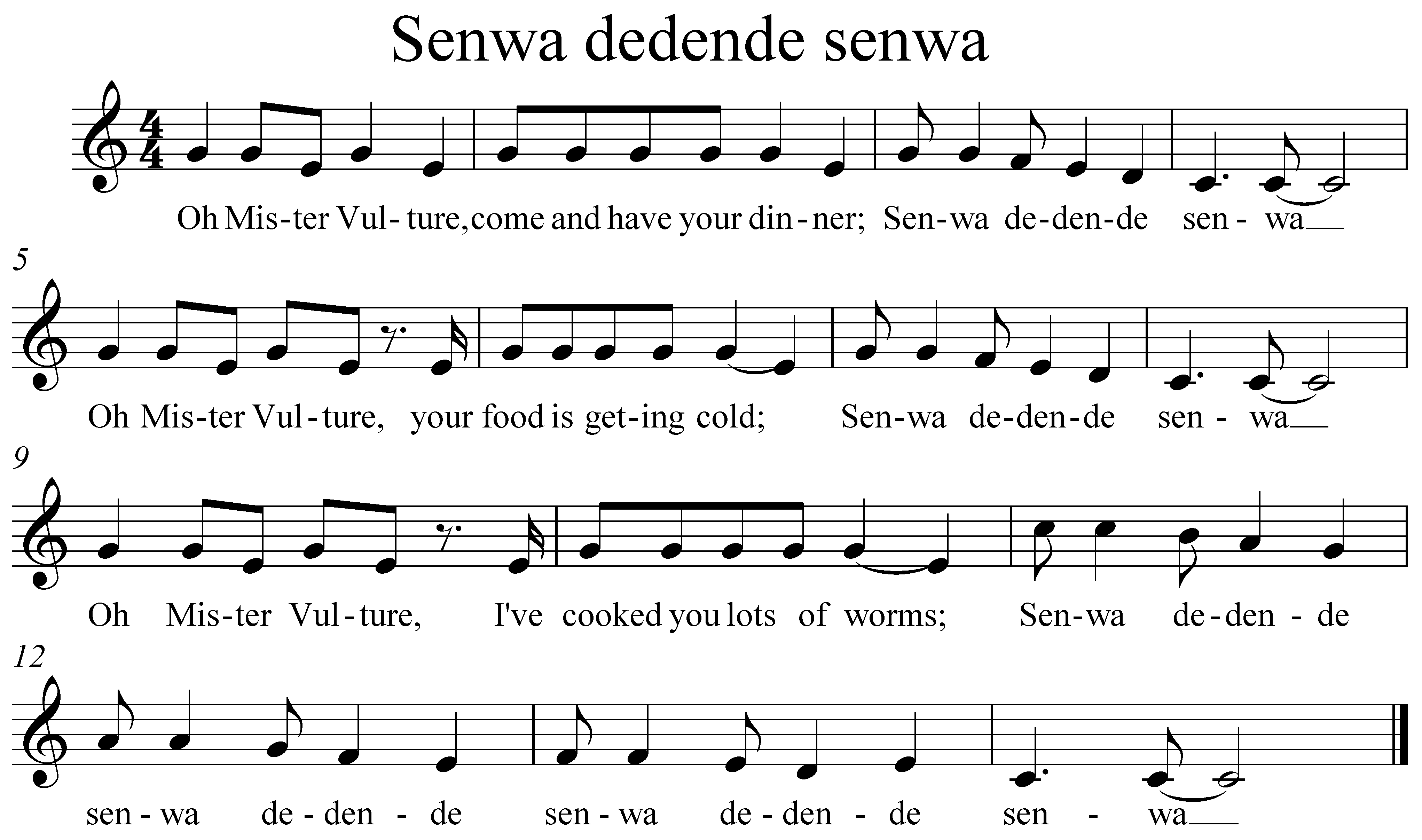
Issue 29: Senwa Dedende

I have found this song in various books, including the Kodaly book “How Can I Keep from Singing”. It is also on the singup website at

http://www.singup.org/songbank/song-bank/song-detail/view/9-senwa-dedende/.

This is a lovely song, and works very well as a round – listen to how they do it on singup for inspiration. I understand that it is part of a long call and response song about a mother vulture calling her husband home for his meal.

Here is my version, where the caller makes up lines about calling the vulture home, and the class responds using the phrases of the song. It is based on what I can remember from a Ghanaian djembe teacher sang to us, several years ago. I expect it is not very authentic, but if “Frere Jacques” can turn into “I hear thunder” in England, and “Two Old Tigers” in Chinese, then hopefully I can be allowed to use Senwa dedende as a starting point for call and response improvisation. The class thoroughly enjoyed thinking up suitable food to entice Mr Vulture home for his dinner, and I was encouraged by the number of children prepared to sing out in front of everyone.

Posted in Songs, Uncategorized | Tagged , , , , | Leave a comment

Issue 29: The Swan – Again

It is at about this time of the term that I start working with the current cohort of music exam candidates, ready for the Fateful Day at the end of the month. The lists of exam pieces for most of the instruments have stayed the same for several years now; Grade 1 flutes nearly always do “Greensleeves” and “Hot Chilli”. Grade 2 flutes have a hectic couple of minutes with “Marche Militaire” and “Liberty Bell”. Grade 1 violins do “Fanfare”, “Country Chimes” and “Toodle Pip”, and it came as no surprise that the Grade 2 saxophone candidate presented me with “Greensleeves” (in an entirely different key and arrangement to the flutes) and “Chinese Take It Away”.

Over the course of an hour and a half I went through all the usual issues; dotted-crotchet-and-quaver rhythms for the flutes in “Greensleeves”, and their tricky moment with a G# which always catches them out, the total inability of grade 1 violins to count three quavers for dotted crotchets in “Country Chimes” , and a determined battle about counting rests in “Chinese Take It Away”. I was down to the final half hour session, and discovered myself facing a young lad, his saxophone, and, horror of horrors, “The Swan”.

Early aficionados of the Music Jungle will already know my opinion of accompanying Grade 4 saxophonists careering through “The Swan” with anything between 4-and-half and 7 beats in the bar, while I am wrestling with handfuls of relentless semiquavers arranged in uncomfortable combinations. My heart sank as he handed me the music. Bitter experience has taught me that it is necessary to thoroughly check that the saxophonist can actually count to 6 before I make any attempt on the torrent of notes that await me.

“Let’s hear how you play it, before we try it together,” I suggested, hiding my dismay as best I could.


He took a deep breath and dived in.


Well, I have to say he has managed to redeem “The Swan” as a reasonable, feasible choice for Grade 4 saxophone. He played the whole thing through at a steady, respectable tempo, with 6 beats in all the bars. There was only one small rhythmic niggle which was easily sorted out. The only thing left is for me to learn the accompaniment again. Well done that lad!

Posted in Uncategorized | Leave a comment

Apologies to our regular readers!

I have just checked the statistics for the site, and discovered that there were a lot of visits on Friday 2nd and Saturday 3rd March – but of course I was late this week, and if you were hoping to find something new, you will have been disappointed!

Usually I manage to update the Music Jungle on Friday evenings ready for the weekend, and will continue to do so. However, I am a working music teacher and very occasionally, working can overwhelm even the most well-organised weekly schedule.

Anyway, here is a bonus post: (I found it here: http://www.guitar-theory-in-depth.com/music-quotes.html )

“I like any and all of my associations with music -writing, playing, and listening. We write and play from our perspective, and the audience listens from its perspective. If and when we agree, I am lucky.” -Duke Ellington

Posted in Uncategorized | Leave a comment

Issue 28; Welcome to the Jungle

Hello – I apologise for the late arrival of issue 28. Friday somehow became absolutely fully booked. Saturday morning is Early Years music teaching, and Saturday afternoon became an urgent quest for a replacement power supply, as the one I use – or rather, was using – for my portable amplifier gave up the ghost (right at the beginning of the first Early Years session this morning!).

Anyway, better late than never. Issue 28 contains a pulse game with potential to become a composition activity, an Early Years game, and memories of listening to gamelan music in Indonesia, brought about by the Poulenc concerto for two pianos.

Posted in Uncategorized | Leave a comment

Issue 28: The Game of Four – Warm up and Compostition

This has proved to be a useful warm up for any session involving keeping a steady pulse, and learning to internalise the pulse.

As a preparation, do the “counting to eight game” first, to establish a pulse.

Now, explain that you (the teacher) are going to clap four beats, then there will be silence for four beats, then the class claps four beats, folloowed by silence for four beats.

Like this; Teacher in italics, class in bold

clap clap clap clap sh sh sh sh clap clap clap clap sh sh sh sh clap clap clap clap sh sh sh sh clap clap clap clap sh sh sh sh

Repeat this sequence, aiming for total silence in the rests. Some children will be almost unable to stop themselves clapping on the first beat of the silence, some will clap with the teacher instead of waiting for their turn. Persist, insist, until everyone is concentrating – but quit when before everyone loses concentration again!

Moving on, divide the class into four groups. Each group claps four times in turn, maintaining the pulse eg

clap clap clap clap clap clap clap clap clap clap clap clap clap clap clap clap                                                        with the different groups indicated by bold or italic.

when this is going well, try two claps each; clap clap clap clap clap clap clap clap

and then one each; clap  clap clap clap

Finally, transfer this activity onto intruments; school percussion, boom whackers, small group tuition, samba groups, djembe, whatever you happen to be teaching at the time. If you are using pitched instruments, just decide on the note, or chord, for each group first. If you are using unpitched percussion, you can use this as an opportunity form the groups to explore the effects of different combinations of sounds – eg metal, skin, shakers, claves in separate groups or all mixed together.

Aha! a composition opportunity, perhaps combining pitched notes, rhythms and timbre! Perhaps you can vary the rhythms played by the groups, alternate pitched and unpitched notes, create a numerical graphic score, divide the class into smaller groups to create their own group compositions on a theme…….

Posted in Clarinets, Composition, Djembe, Keyboards, Ocarina, Recorders, Samba, The organised teacher | Tagged , , | Leave a comment