Issue 18: Radio 4 – What a resource!

I was using radio 4 iplayer to catch up on “Book of the Week” broadcasts, and idly searched on schools and music. Talk about findng buried treasure! Wow!

Here is the home page, where you will find all the material sorted by subject;

http://www.bbc.co.uk/schoolradio

Try History; you can get hold of Victorian, Tudor and World War II music.  Or in English you will find story readings – these might make a starting point for composition activities.

Here is the link for Music;

http://www.bbc.co.uk/schoolradio/subjects/music

There are a number of different sections for different keystages.

For example, for keystage 2, the new topic for this coming term seems to be Greeks, with David Grant teaching a number of songs following the story of the Heroes of Troy.  Here is the first lesson;

http://www.bbc.co.uk/schoolradio/subjects/music/troy

with accompanying vocal and video downloads.  The teachers notes are very comprehensive and include instructions for saving all the downloads to your own computer including song words, music, and a script so the children could perform the play themselves.  Curriculum information is also included.


Here is another fantastic link for sound clips illustrating the music elements (pitch, duration etc) and also world music.

http://www.bbc.co.uk/schoolradio/subjects/music/clipslibrary

A massive amount of these resources are available to download; try this link

http://www.bbc.co.uk/schoolradio/downloads

and it’s all free! Amazing! You will find sound clips for Tudor music, Victorian music, sounds of World War II, many stories such as “The Wind in the Willows” read by Bernard Cribbins…. what riches.

If you want to save various recordings, you need to keep an eye on the podcasts. They are available to download for a short while after the broadcast, but then disappear. It is possible to subscribe to a series to receive all the podcasts; the link for this is here;    http://www.bbc.co.uk/schoolradio/podcasts

Used creatively, these resources are magnificent! I guess many non-specialist teachers will be sorely tempted to line up their pupils in front of the whiteboard, set the recordings going and sit back and let it all run its course; and that will be a lot better than the now infamous lessons of “colouring-in to music” of old. As music specialists, it offers us a chance to collaborate with our class-teacher colleagues, using each other’s specialist skills to teach in a well-rounded, cross-curricular way.

Posted in Listening Music, The organised teacher, Uncategorized | Tagged , , , , , , , , , , , , , , , | Leave a comment

Issue 17: Welcome to the Music Jungle

End of term coming up! I think that the last two weeks of the Autumn term are often the busiest in the whole school year.  In years gone past, when my children were in different schools and I was teaching in two different schools, I could find myself in charge of organising two Christmas Nativity Plays, and assisting at two Carol Services, and attending two plays and two carol services as a proud parent.

There are two Christmas-themed postings in this issue; a class activity using the ancient carol “Gaudete” and a memory-jogger list of a few very simple carols and Christmassy tunes.  The third item is a possibly controversial (but extremely effective) incentive tool that I often use in private piano and theory lessons.

Posted in The Jungle, Uncategorized | Leave a comment

Issue 17: Easy Christmas Carols and Tunes

This is a bit of a post-in-a-hurry; but here are a few ideas;

Mary had a Baby, yes, Lord

Mary had a Baby, yes my Lord

Mary had a Baby, yes Lord

The people keep-a-coming and the train done gone.

The first phrase, “Mary had a Baby” uses just three notes; for example C D E or G A B, as does the last phrase “and the train done gone”.


Jingle Bells needs no encouragement; being the only five-note carol I have now taught it on recorders, clarinets, keyboards, chimebars, pianos……


Christmas is coming, the geese are getting fat. Please put a penny in the old man’s hat.

If you have no pennies, a ha-penny will do,

If you have no ha-pennies then God bless you.

This uses the tune of Pease Pudding Hot; notes CDEF or GABC


And of course, good old Hot Cross Buns – seasonally altered to Hot Mince Pies

Hot Mince Pies, Hot Mince Pies. One-a-penny, two-a-penny, Hot Mince Pies.

the easy tune uses just BAG or EDC. It works as a simple round if you want to make more of it.

Posted in Clarinets, Keyboards, Ocarina, Piano, Recorders, The organised teacher | Leave a comment

Issue 17: Gaudete – Steeleye Span

Years ago, I played this track to Keystage1 children in a music lesson around Christmas time.  The children were fascinated by the strong contrast between the gruff, strong singing of the chorus, and Maddy Prior’s clear solo voice in the solos.  (There are various versions of it up on YouTube if you haven’t heard it before).

Within minutes, one of the children (who was usually the bane of my music classes) had set all the children to stomping around the hall during the chorus.  That left us with nothing to do in the verse – his idea was to run riot until it was time to march again.

In the end we developed it into a successful contrasting set of movements; in the chorus, one group if children (mostly boys, it had to be said) marched round the hall in two columns, while the other group stood still, and in the verse, the other group skipped in a long line around the rest of the space, weaving in and out of the stationary soldiers.

I have also occasionally created a simple set of country dance-style movements to go with carols.  The problem is to find recordings which keep going through all the verses without stopping, unlike standard church-style recording which always take a deep breath between vereses.  The Saydisc CD “Tapestry” is quite a good one for this, with lots of well known carols played in a folk idiom.


Posted in Lessons that have happened, Songs, The organised teacher | Tagged , , , , | Leave a comment

Issue 17: Rewards and Incentives – Stars and Scissors

Everyone knows that children – small children – will do anything for a sticker.

This simple reward loses its power as the children grt older and the children become totally blase about even super-shiny-glitter-stickers.  There is a way to increase the power of the sticker using a simple pair of scissors.

The Star and Scissors Game/Challenge

This method is not going to find favour with every reader, and, as a teacher, I am very careful to ensure that no child is permantently traumatised or damaged by the star and scissor experience.  However, used judiciously, you can make huge improvements in focus and learning with a single snap of the blades (but remember health and safety, and don’t snap them anywhere near yourself of the child).

The procedure is simplicity itself.

You carefully teach the learning point in question; it could be reading notes in bass clef, a scale, a short phrase, a tricky bit of fingering, remembering a Da Capo repeat.  You want it to be short, exact, and achievable.  Bring out the stars and the scissors, and explain that if they get the task completely correct, they will get a star (you can see older pupils thinking “yeah, yeah, a star, so what”), but you will snip off a point (the word “snip” is somehow more powerful than “cut”) for every mistake, and then they get what’s left of the star.  You can see disbelief, and a narrowing of the eyes, as the child prepares to meet the challenge.  To increase the drama, I allow them to choose the colour of the star, suggesting that they don’t choose their favourite colour in case it gets snipped.  Away we go.  “Snip!” and again “snip!”.  The snipping will usually put them off first time round, but that’s okay; offer them another chance as you stick a three-pointed star into their practice book.

It can be a messy business, especially if you have to cut all five points off the star and you are trying to stick just the centre into their book while your fingers and the blades of the scissors are covered wih dismembered points.  The children actually seem enjoy the visual aspect of seeing their improvement, in the form of stars with increasing numbers of points lining up in their books.

It helps me too, as a teacher; there are times when teaching a child can be extremely frustrating, and savaging the stars with scissors can be a form of release.

Warning – however provoked you are, NEVER, never use animal stickers for this game.  How could you ever bring yourself to snip off the snake’s tail?


Posted in Lessons that have happened, The organised teacher | Tagged , , , , | Leave a comment

Issue 16: Welcome to The Music Jungle

December! Where did the months go!

In this week’s issue there are some book recommendations, a way of improving note reading skills for new beginners, and an Early Years activity the “The Noisy Box“.

I’ll leave you to read on – I’ve planning and practising and paperwork to do (haven’t we all?)

Posted in Uncategorized | Leave a comment

Issue 16: The Inner Game of Music and Musicians

In every human endeavor there are two arenas of engagement: the outer and the inner. The outer game is played on an external arena to overcome external obstacles to reach an external goal. The inner game takes place within the mind of the player and is played against such obstacles as fear, self-doubt, lapses in focus, and limiting concepts or assumptions. The inner game is played to overcome the self-imposed obstacles that prevent an individual or team from accessing their full potential.   

Francine du Plessix Gray, Blissing Out In Houston, New York Review of Books, December 13, 1973

The inner game of music [Book]

Timothy Gallwey’s books on “The Inner Game” have been around since the seventies as you can see from the publication dates below  (which I have lifted from the wikipedia article on Timoty Gallwey).  I found the book “The Inner Game of Music”, which Barry Green co-authored with him, a useful read.  It applies the insights that Gallwey used to improve the performance of sportsmen to the particular needs of musicians wishing to improve musical performance.


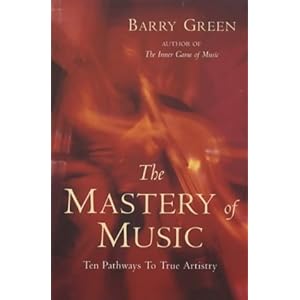
Mastery of Music: Ten Keys to Musical ExcellenceI have also enjoyed Barry Green’s “The Mastery of Music”  (ISBN 1-4050-0009-0).  It is entertaining and interesting; he takes ten aspects of muscianship, eg “Communication”, “Passion”, “Discipline”, and, using particular types of instruments, delves further into the inner workings of music.

So, for “Courage”, he considers the demands made upon the French Horn and Percussion players; for “Tolerance” he looks to the violas, for “Fun” he interviews trombone, tuba and double bass players.  I was amused and intrigued by his choices of instrument to illustrate these qualities.

I’m looking forward to having time over the next few weeks to read these two books again – for amusement, interest, and professional developmnt all in one go.


  • Gallwey, W. Timothy. (1976). Inner tennis : playing the game. New York: Random House. ISBN 0394400437.
  • Gallwey, W. Timothy; Kriegel, Robert J. (1977). Inner skiing (1st ed.). New York: Random House. ISBN 0394420489.
  • Gallwey, W. Timothy (1981). The Inner Game of Golf (1st ed.). New York: Random House. ISBN 0394505344.
  • Gallwey, W. Timothy (1985). Inner Game of Winning. Listen USA. ISBN 0-88684-064-3.
  • Green, Barry; Gallwey, W. Timothy (1986). The inner game of music (1st ed.). New York: Anchor Press/Doubleday. ISBN 0-385-23126-1.
  • Gallwey, W. Timothy. (2000). The Inner Game of Work. New York: Random House. ISBN 0375500073.
  • Gallwey, W. Timothy. (2009). The Inner Game of Stress: Outsmart Life’s Challenges, Fulfill Your Potential, Enjoy Yourself. New York: Random House. ISBN 140006791X.


Posted in The Jungle, The organised teacher, Uncategorized | Tagged , , | Leave a comment

Issue 16: Can’t they read music yet?

So, you have been teaching the children for a whole term, and they still can’t read the music yet!  How hard can it be to read just three notes?

The most single effective tool I use in assessing whether the children can read music is composing music.

Take a piece of standard manuscript music and enlarge it on a photocopier, or else create it using word. (table with four rows and no columns, font size 5).  Demonstrate, or even better, get the children to demonstrate where the notes lie on the stave. Compose a short phrase in crotchets using the notes that you expect them to know, and get a child to play it.

After a couple more demonstrations, issue everyone with manuscript paper and pencils (it is handy to have a couple of rubbers and sharpeners around as well) and get them to compose and play their own music.  You can now circulate and see how they are getting on.

The noise is horrendous – 35 beginner recorders all composing and playing using BAG is not a nice aural experience.  One OFSTED inspector left in a hurry at this stage of the lesson, saying they would return when we were doing singing.  I don’t blame them!  However the children really enjoy discovering that they can read and write their own music.  It is also a golden opportunity to make an individual assessment of each child, and “gather evidence” of where they are in music reading fluency.

You might like to refer back to the “aliens” article, back in issue 4, “Here come the Aliens” for further ideas for teaching notation.

Posted in Composition, Lessons that have happened, Theory, Uncategorized | Tagged , , , , | Leave a comment