Issue 20: Changes to the Singup Website

Whenever I want to find a new song, this site; www.singup.org, is one of my first places to search. This fantastic, free resource has been full of good ideas since it started a number of years ago.

However, all is about to change. It looks as though this is about to become a subscription service, if that is a reasonable interpretation of the phrase “affordable membership package”, from April onwards. I am not sure exactly how much I will be prepared to pay as a private teacher in order o continue to be able to dowlnload and use the songs in future.

In the meantime, the glorious years of endless free downloads of music and resources have also come to a sudden and abrupt end; check this link for details

http://www.singup.org/news-local-events/news-article/view/723-sing-up-downloads-update/

in summary we are limited to only 6 free downloads between 21st December 2011 and 31st March 2012.

It will still be possible to use the site as much as you like through the internet to play and display songs through interactive whiteboard displays and computers.

Ah well – it was good while it lasted! And hopefully “affordable” will mean just that?

Posted in Songs | Tagged | Leave a comment

Issue 20: Internet resources for Chinese New Year, Monday 23rd January

Happy New Year! And in just a couple of weeks, Happy Chinese New Year!

This year will the the year of the dragon which will give plenty of scope for exciting and colourful activities.

A quick search on YouTube will come up with plenty of dragon dance videos. Here are two short ones for starters. The second dance is accompanied just by cymbals.

http://www.youtube.com/watch?v=4WUnWPpRslM

http://www.youtube.com/watch?v=apimBqgTeBA&feature=related

The Mamalisa website is a favourite source of mine for children’s songs from around the world. Here is the link to the China page; http://www.mamalisa.com/?p=11&t=ec&c=11


Posted in Composition, Listening Music, Songs, The Jungle | Tagged , , , | Leave a comment

Issue 20: Composing using Pentatonic Scales

Pentatonic scales are used in music all over the world. They are scales that use just five (penta) different notes (tones). The scale that sounds most familiar uses the first, second, third, fifth and sixth notes of the scale;

do, re, mi, soh and lah

Pentatonic tunes occur all through British Folk Music – for example, try picking out the tune of “Over the Sea to Skye” using just the black notes on a piano or keyboard.

If you are using chime bars, or glockenspiels, choose one of the following groups;

C D E G A, or F G A C D, or G A B D E

(The black notes on the keyboard are F#, G#, A# C# and D#, which is similar to the second group. Music specialists will now insist that I add that they are also called Gflat, Aflat, Bflat, Dflat and Eflat, which is similar to the third group. I’m not sure if I should really enter these murky waters, and anyway you don’t need to know all this in order to be able to play tunes on them!)

On a descant recorder the notes would be D E G A B, which are the same letters as the last set of chime bar notes. As a general rule, you can use these notes in any order, so long as they all come from the same group – if you have a mixed selection of shorter and longer chime bars, experiment to see what is the best way to group them.

The notes high-lighted in bold can be used as an accompaniment to the melody.

The beauty of pentatonic scales is that you can play the notes in any order, and in any rhythm, and always end up with a sort of melody. It is also fairly easy to devise a simple system of notation to record your composition.

So, here we go; I’ll use the set of notes C D E G A.

First we need some words. As Chinese New Year is coming up, I’ll use that as my inspiration;

Hap-       py,         HappyhappyChin-ese New  Year

The spacing between the syllables gives an indication of how I want to say the words; And then I’ll choose letters for the different syllables; and again, the spacing between the letters gives some indication of how quickly or slowly to play the notes.

G               E          AAAAD  E   G         E

So, by writing the letters under the syllables, and spacing out the syllables, you can notate your composition. All I need is for someone to pay a steady beat using C and G, and maybe tap a cymbal with a soft beater on each of the words “Chinese New Year” and I have the beginnings of a Chinese New Year piece.

It really is that simple – please have a go!

Posted in Composition, Keyboards, Recorders, Songs, The organised teacher | Tagged , , , | Leave a comment

Issue 19: Welcome to The Music Jungle

This has to be the last issue of the year!

There are two articles this week. The Music Lesson Gone Mad is just a bit of fun. The Singing Playgrounds article is a bit of a mammoth effort – I suppose I could have posted it week by week and made seven articles out of it, but I think it is far more useful as a complete item. basically, it is how to fill half your music lesson every week for the next seven weeks or more, teaching five singing games and combining them all into a challenging and exciting performance. I hope you try it out; I have had huge pleasure in doing this activity all through keystage 2 in half-a-dozen different schools over the last couple of years and it has always been a huge hit with the children.

Posted in The Jungle | Leave a comment

Issue 19: A Bit of Nonense

In the grand tradition of English Comic Verse, and with apologies for all deficiencies in rhythm and metre, I offer you the following bit of doggerel. I put it together to re-use some of the illustrations from the 2011 issues of The Music Jungle. I will snail-mail a tiny and insignificant prize to the first person who gets in touch with us via contact@themusicjungle.co.uk and correctly identifies the source articles for all the illustrations.


A Music Lesson Gone Mad


What a noise! What a din!

Someone’s let the monkeys in

And round and round and round they run

Until they find the African drum.


Elephant’s child is in a bate

‘cos no-one wants to stop and wait

While he mends his clarinet

Which broke when he, unmindful, stepped

To left, instead of to the right

To avoid the beetle, just in sight

Who called out “Watch it! Stupid boy

Couldn’t you hear me shout ‘Ahoy’?”


Here comes that monkey, it can’t keep still,

What is that shriek, so loud and shrill?

Arrrgh! Oh no! He’s found the recorder.

(Ear muffs and aspirins are now in order.)

The parrots flap about and add

Their powerful squawking to the mad-

ness that engulfs the room.

It doesn’t help when they start to zoom

Above the rumpus down below

Where frayed nerves begin to show;

This is what happens when the teacher leaves

The children to do just what they please!


Posted in The Jungle, Uncategorized | Leave a comment

Issue 19: Mega Whole-Class Singing Activity – Singing Playgrounds

On the website, www.singup.org, is a set of playground singing games called “Singing Playgrounds”, which is a wonderful resource for at least half a term’s work.

At its simplest level, there are five songs to sing through, which all work together as partner songs and have games and actions to go with them..

“Concentration” is a circle game which is a opportunity to learn the children’s names,

“John Kanakanaka” is a simple partner action song,

“Eh Memarie” is another circle game,

“Here Comes Sally” will become a wildly popular playground game,

“Tancszmy Labada” is another circle game.

The genius part is that as my colleagues and I started teaching the songs, between us we developed a complete
program of linking the games and the songs into a great long performance as follows. Don’t panic – the long, long explanation that is coming up is much easier to follow than it looks. I have done this now about a dozen times in different schools, and it has been one of the most popular activities ever.

Week 1 – teach “Concentration”. The tune is very simple, so it is likely that the children will be able to play it on whatever instruments are around – percussion, keyboards, clarinets, etc. Instructions for the game are on www.singup.org

Week 2 – teach “John Kanakanaka”; This is a call and response shanty, and the opportunity to create new words for the call. The actions I use require the children to stand facing a partner. They do a “dos-si-dos” during “I heard, I heard, the old man say” and also “Today, today’s a holiday”. Stamp on John, pat knees for each syllable of “Kanakanaka”, clap own hands for each syllable of “Too-li” and partner’s hands for “ay”.

Week 3 – teach “Eh Memarie” as a circle game (I have heard of other versions of this game, eg “hot potato, pass it on” and even a Brownie version which I am assured by these particular Brownies is called “pass the bogey” – but you might not want to share this particular factlet with the children. The children stand in a circle, hands palms up, each child’s left hand under their neighbour’s right hand, and their right hand over their neighbour’s left hand. The person who starts, pats their own right hand over onto their left-hand-neighbour’s right hand, who repeats the movement so that the “pat” travels clock-wise round the circle in time to the pulse (now you know why another name for the game is “pass the bogey”.) When you sing “one-two-three”, whoever is supposed to receive the “pat” on the word “three” snatches their hand away, so that the patter pats their own two hands together.

Week 4 – teach “Here comes Sally” – The children make two lines with an alley between them. Label one side “Sally” and the other side  “The Other”. In the first section, (“Here comes Sally”) the top person from the “Sally” line goes down the alley, doing a funny walk.I always get them to join the end of the “other” line, so that they swap ides. In the next section (“Here comes the other one”) the top person from the ” Other” line copies the way Sally went down the alley (and then joins the Sally side, to swap sides). You continue with the song; the children will soon put actions to the words; for example we clap hands on the word “whup”. (Shy children can be directed to nip down to the bottom of their line, thus avoiding having to have a go until they are more confident)

Week 5 – teach “Tancszmy Labada” – be warned – it took me most of the week beforehand to get my tongue round the words! This is how I play this game; the children stand in a circle and I stand in the centre. After the first time through the song, I call out “have we done walking?” Response “no”, so we repeat the song, all walking round
in the circle. Then I call “have we done walking?” “yes!”. “Have we done hopping?” “No!”, so we repeat the verse, all hopping round. Then I call “Have we done walking?”  “Yes” “Have we done hopping?” “Yes” “Have we done kangaroo jumps” “No” We all kangaroo jump round, while jerkily singing the song. “Have we done walking” “yes” “Have we done kangaroo jumps”  There is a chorus of “you’ve missed out hopping”. So, becuase I made a mistake in reciting the list of actions in the correct order, I am out. A new leader is chosen – I do this by holding out my hand and pointing at the children, slowly turning round with my eyes apparently closed to “randomly” choose someone “suitable”.

I have been assuming that each week you have been revising the previous songs and games. Now for the grand performance stage 1;

Week 6 –  the tricky bit – putting the first part together

Explain that you are going to link all the games togethe. Listen to the performance track so you know how it
works. Before you do all the songs with actions, you need to get organised!

Arrange the children in two concentric circles facing each other, so they all have partners for “John Kanakanaka”.

Practice getting the hands sorted to make outer and inner rings for “Eh memarie”. You want the inner ring of children to stay facing their partners rather than turning round. It’s a little awkward but not impossible. Choose who starts the game off for each circle.

Define one circle as “Sally”, and the other as “The other”; choose one person to be Sally, and their partner to be “The Other”. They will go round between the two circles when we get to that song.

Explain that in “Tancszmy Labada”  we will be doing “walking” – if things are going really well, you might be able to get the circles to go in opposite directions – practise this first!

Right – WALK THROUGH THE WHOLE SEQUENCE BEFORE YOU TRY WITH THE MUSIC!

do all the songs with their actions in order; “concentration” actions are now pat thighs, clap, click, click, “John
K” actions with partner in opposite circle, “concentration”, “Eh memarie” in two circles facing each other, “concentration”, “Here comes Sally” with Sally going through alley between the two circles and back to his/her place, followed by “The Other”, “concentration”, “Tancszmy” with both circles walking round, “concentration” and HIT THE PAUSE BUTTON. Stop there for this week.

Week – 7 the songs all work together as partner songs, as you will have realised. So, to do the whole performance, I arrange for the children to divide into four groups, roughly according to the quadrants of a circle. It helps if there is some easy way – like floor markings or maybe features like posters on the wall to act as reference points. having done all the actions as above, the children now stand in their four groups. They won’t necessarily know which group they are in until they get to this part of the performance, which is why they need some kind of visual reference to know what they have to do. Each group is allocated a song. All sing “Concentration”over and over until their song starts; group 1 will organise themselves into pairs and sing and play “John Kanakanaka”; and will carry on doing it until the end. Group 2 sing “Concentration” over and over until it is time for “Eh Memarie”; then they sing and play that. Group 3 need to be ready for “Here come Sally”, and finally Group 4 start “Tanczmy Labada”.

You will probably need to listen to this section of the performance recording several times to get the hang of it; if the children sit down at the end of the first part, and then mime what they should be doing they will son catch on.

And more…..

I have used all or some of the tunes of the songs with treble and descant recorders, clarinets, and keyboard
roups depending on the expertise of each group; I just transpose the tunes into whatever key best suits the instrumental group I am working with.


Posted in Clarinets, Keyboards, Lessons that have happened, Listening Music, Recorders, Songs | Tagged , , , , , , , , , | Leave a comment

Issue 18: Welcome to The Music Jungle

And relax! I have taught the last class, taught the last pupil, attended the last concert of the year!  This time last year I was in Copenhagen for a Christmassy weekend, having caught more or less the last flight out of Gatwick before the snow descended like a thick white blanket and stayed for several weeks.

I expect I am more likely to be doing Christmas shopping than planning over the next few days; however I have stumbled across the radio 4 schools site and found an amazing source of sound clips and other resources which I shall be investigating in detail when I do get around to thinking about next year’s lessons.

The only other thing to say is to wish you all a Merry Christmas, and a peaceful, relaxing end to the year.


Posted in The Jungle | Leave a comment

Issue 18: Happy Christmas to all our Readers

Thank you to everyone who has been visiting this site since we started in August 2011. I hope you have a very Happy Christmas, and wish you all the best for the coming year.

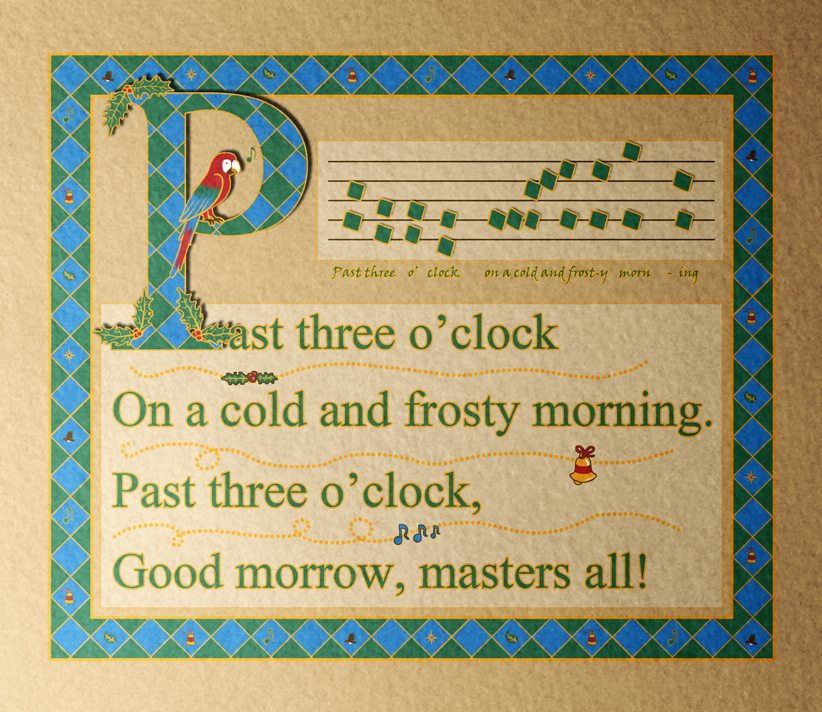
We are hoping to be able to offer various resources, and a method of buyng, them early in the New Year.  Meanwhile, I hope you enjoy our Christmas Card – an intriguing combination of ideas from the MusicJungle and from the visit to the Illuminated Manuscript Exhibition at the Brisitsh Library earlier this year.

Posted in The Jungle | Leave a comment