48/100 Prior Learning – It makes a difference!

I’ve just had a bit of a wake-up call about the importance of regular music lessons.

At the primary school where I teach music all the way through from Reception to Year 6, I thought it would be a fair assumption that if I get my year 3s together, issue them with samba instruments, do a quick warm-up and explanation, they should be able to play a decent, if simplified, version of samba reggae from the Beatlife Book by the end of a 45 minute lesson.
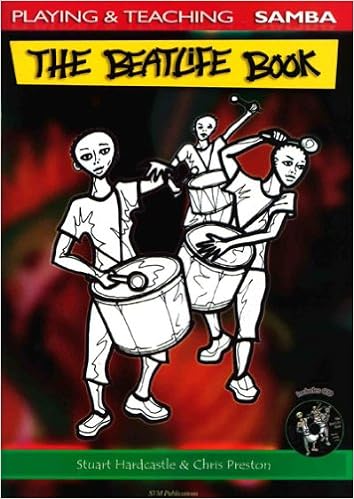
 

Indeed, that is exactly what happened when I tried it. They all had nailed their grooves and could hold them when playing all together, watch for section breaks and stop signals, and even do a pretty good stop.

The I went to do one-off samba workshops with classes in schools where I don’t normally teach. Revelation. What I took to be perfectly achievable, reasonably straightforward lessons plans for years 3, 4 5 and 6 turned out to be much harder to achieve. In the end, each year group did manage to play their sambas, in simplified versions. I had the sections playing similar/identical rhythms, combined the separate surdo parts into everyone playing the same thing. Year 6 were the most proficient; but they had done some samba several years ago and therefore had more experience of playing rhythmically, watching for signals, keeping a pulse.

I’m going to have to rethink my plans for future workshops in the light of this experience.

It has also been a very encouraging experience – what I take for granted with the children I teach “in my own schools” is actually a reflection on the fact that they have benefited from all the music that they have experienced over the years. It really does make a huge difference to their ability to learn, play, control, perform.

birds on a branch divider

Posted in Lessons that have happened, Samba, Workshops | Tagged , | Leave a comment

47/100 Learning to Play Slurring Patterns

The Paul Harris Practice Starter Cards I mentioned a while back are proving a great way to begin lessons.

Today I was teaching a piano lesson to a beginner, and she pulled a card which suggested you try playing a phrase in different ways. For example, alternating bars of piano and forte, or of legato and staccato, playing it as slowly as you can (that’s what she chose to do; a bit of emergency practice going on there, I suspect!) and so forth.

One of the ideas was to try different slurring patterns. Aha! A chance to re-visit what slurs are, and how to interpret them!

There was a little exercise along these lines her her tutor book. I copied these few bars into her practice notebook

slurs removed


and added these slurs, and the fingering. And also the words: by grouping the fingering patterns into numbers, she very quickly understood how to group the notes into the different slurring patterns, joining the notes over the slurs, and detaching the other notes.

untitled


When I put £ signs before the numbers like this: £24  £24:    £242 £2:     £2 £42 £2:     £2  £424:   it made even more sense to her!

When tackling the next piece on the page, her attention was immediately caught by the slurs; two three-note phrases (£531 each), a five note phrase (£54323), and then, joy of joys, an eleven note phrase (£53153154321) I left her to work out how that one would be worth for next week.

Snake keyboard divider

Posted in Lessons that have happened, Piano | Tagged | Leave a comment

46/100 How to know when to start a rest

Further to the previous post – this is something I leaned from my second-ever piano teacher:

Have a look at this Clementi sonatina:

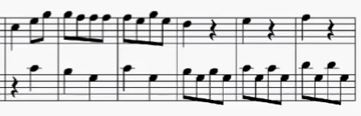
Clementi op 36 1 restsThe trick is to tie the release of the single crotchets to the note being played by the right hand. (This so much more complicated to explain than to do).

Anyway, what I do is practice releasing the first left hand note when I play the second note of the right hand. The same happens in the next bar. In the third bar, I learn to release the left hand notes at the same time that I play third and seventh quavers in the right hand. And so on and so on, throughout the piece.

That way, the crotchets in the left hand will always be exactly the right length in relation to the right hand melody.

This principle can be applied anywhere there is a detached accompaniment to a melody, in either hand. Because this “learning” goes into the “muscle memory”, it will stick, freeing up brainpower to focus on other vital elements of performance.

cracking the eggs

Posted in Lessons that have happened, Piano | Tagged | Leave a comment

45/100 Finding the Right Words

I’ve just finished teaching some young adult beginners piano pupils, but this post applies to all instrumental teaching.

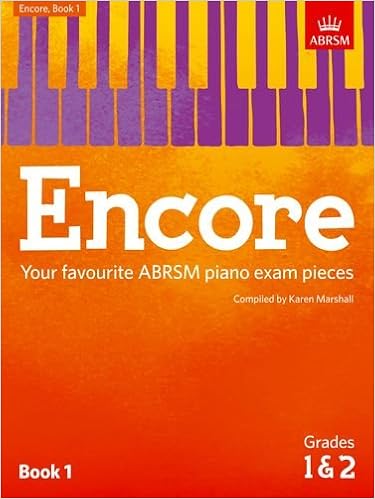
We are tackling some pieces from the “Encore” book grade 1 and 2, which are a slight stretch in level for the stage that they are at right now, but they are managing very well.


I’m now looking for more exactitude in when notes are released. This isn’t one of the pieces from “Encore” but it serves to illustrate the point;

Clementis Arietta rests

(from the piece Arietta by Clementi). The trick is to get the student to listen carefully to themselves, so that they hear if they are holding the notes (in this case the right hand crotchets) for exactly the right length.

By chance, I found the words to “make it happen”. Usually, I try and get them to play at a slower tempo, so that they can hear and control the sound. For some reason, I asked them to “Zoom In”, instead of “play it slower” to hear the detail.

If that’s not a mixed metaphor, I don’t know what is, but it did the trick. Both pupils played slower, and with increasing accuracy, able to hear for themselves whether the notes were of the correct length. Result!

fanfare for the common ant

Posted in Lessons that have happened, Piano | Tagged | Leave a comment

44/100 Paper Chime Bars

By the way, you might be wondering about the weird numbering system I am using for the Jungle Posts at the moment. That’s because I am trying to get at least 100 posts up this year, to make up for the random and sporadic posting of the last year.

Now, about these Paper Chime bars. That’s a way around the situation when you are trying to teach year 1 and 2 to read pitch notation, and you have a class of 30, and only 5 sets of chime bars.

So, I sorted the children into 5 groups (well, actually, the teacher did it, see previous post for method!) and sat them down in their rows. I handed each child a piece of paper with two chime bars drawn on it, labelled C and D, and started with the lesson. (I say “pictures”; actually I just drew two vertical rectangles, the left hand one slightly larger, labelled “C” and the right one labelled “D”. You can fit two pictures to an A4 sheet, photocopy them, cut them and be ready for action in just a few minutes),

When they were reading C and D from flash cards without any hesitation, I passed a pair of chime bars and a beater to the child in the front row, and instructed them to put the bars on top of the pictures (that way they get them the right way round from the beginning). Then we went through the cards again, passing the chime bars back down the row after two cards.

The children seemed happy enough to play paper chime bars while waiting for their turn, and it certainly made for a quieter lesson. That school has bought another five sets of chime bars which should be there ready for the next lesson. We’ll still be using paper chime bars though to begin with.

Great Wall of Chimebars

Posted in Class Teaching, Lessons that have happened, Resources | Tagged | Leave a comment

43/100 Sorting children into Groups

Last week I learned a brilliant way of getting children into groups.

I’ve only been teaching for about 20 years – how come I never worked this out before? Well, maybe I have used this method, or something similar, in the past, but sometimes the past can be a long time ago and have fallen out of my memory.

Anyway, here you are;

Suppose you want four groups;

Choose four children, “label” them 1, 2, 3, 4. Get them to stand in a row facing the same way, holding up 1, 2, 3 or four fingers. Now, explain to the rest of the children, that as you give them a number, they are to line up BEHIND their leader.

This is the important bit coming up now; ask the child that you are about to start with, and say “so, if you are a ‘1’, where will you go and stand?”. Hopefully, they will tell you that they will go behind the number 1 leader. “That’s right, show me,” you say, and they toddle off and stand in the correct place. At least, that’s what happened every time, with all five classes last Friday.

So now you can address the rest of the class “Do you all see what you have to do?”. “Yes”, they chorus. You can now zip along through the children counting them off; 2,3,4,1,2,3,4,1,2,3,4…. (I forgot that number 1 had already gone, and so ended up with an extra in that group, but it didn’t matter). Have a quick look in case a Boris and a Michael have ended up in the same group and you want to split them. Now you can send each group to do whatever it is you want them to do (in my case, sit by their instruments AND NOT TOUCH THEM).

Like this “Now, the children in group 1 are going to go and sit by the Big Drums, and (pause for effect) NOT PLAY THEM! We are going to watch them and see if they manage to NOT PLAY THE DRUMS”. Everyone’s eyes follow the children, who cautiously make their way over to the drums and sit down. What’s more, they didn’t touch the drums.

I have to say it made for a very calm and easy start to the lesson.

Flying birds divider

Posted in Class Teaching, Lessons that have happened, The organised teacher | Tagged | Leave a comment

42/100 From Chant to Samba (or Djembe)

There’s a great chant called H E L L O on www.singup.org. It has worked really well as a samba piece. The only problem is you have to be a paid-up member to access it.

BUT, if you are NOT a member, you won’t be able to get at it!

Let’s have a think. How about this?

Hello Samba Chant

Yup, for a first go, that will do nicely. I prefer the words to the Singup one, but this has got the rhythms I want.

So, Teach it as a “Listen-and-copy” chant “Look who’s coming here today” “Look who’s coming here today” ect.

Then turn it into clapping, as in the leader (me!) claps each line and the children copy

Finally move it onto instruments; the leader (still me!) plays a line, the children copy it.

This makes a great introduction to your samba.

Once this intro is secure, allocate a lie to each section eg line 1 ganza (shakey shakey shakey shake); line 2 agogo (Hi-hi lo, hi-hi lo, maybe); line 3 surdo (low high low high) and line 4 to tamborim.

Straight after the intro, bring in each section in turn. Ah, did I mention you should make sure the STOP signal is properly understood before you set this samba rolling? Sorry!

I haven’t mentioned breaks and endings – see what the children come up with, or just introduce the “Don’t Play this one back” game as a break.

For djembe, it’s pretty much the same process – decide which words are tones or bass strokes and away you go,

branch divider


Posted in Class Teaching, Djembe, Lessons that have happened, Samba | Tagged , | Leave a comment

41/100 Milk bottle ganza/shakers

Have you spotted that school milk is now being delivered to the infant classes in mini-sized plastic bottles?

It won’t take long for me to collect a class set of shakers. They need a decent amount of washing to get rid of the stale milk smell. I rinsed them in hot soapy water, and then let them sit in a tub of the kind of disinfectant you use for sterilizing babies’ feeding bottles and other for half an hour and that seemed to do the trick. (You can buy the disinfectant from chemists as tablets and liquids and own-brand – whatever is easiest for you to deal with. It won’t be wasted – I use it for sterilizing descant recorders, ocarinas, samba whistles and plastic kazoos)

They didn’t take long to dry, and I’ve put a small tablespoon of rice into each and screwed the lid on tight. Another infant class is going to collect them, and let the children experiment with different kinds of filling – pasta, beads, paperclips – whatever seems a good idea. Because the bottles are opaque, you could make pairs, marking the bases with matching symbols, and then play games matching the bottles by sound.

If you are playing them as ganzas, hold them sideways on and shake them forwards and backwards for a good crisp sound.

ganza 2

ganza 1


I think these milk-bottle-and-rice “ganzas” make a better sound than the ones supplied in the kit that I use in one of my schools.

As I have already blown the music budget with a class set of ocarinas, the head is very pleased that they are cheapy cheap cheap, and the class teacher will (hopefully) enjoy a little project.

Chatting birds


Posted in Percussion, Resources, The organised teacher | Tagged , , | Leave a comment