Issue 56: Pulse, Rhythm and the Bumble Bee

There is a little playground game song which goes like this;  

Bee, Bee, Bum-ble Bee, stung a man up–on his knee,

Stung a Pig up–on his snout, I say you’re out.

I have coloured-coded the words by pitch as follows; E, G, A. As you can see, this tune is even easier than last’s week’s game, as it only has three notes! If you use simple hand signs to indicate the relative pitches, the children will soon pick it up. If you want to use Kodaly hand signs, E  is Mi,  G is So, and A  is La.

Step 1 is to sing the song, keeping the pulse by tapping your knees, until it is very familiar. Sitting in a circle means that you can easily move to the game.

Step 2 is to check out the difference between keeping the PULSE (tapping on your knees), and keeping the rhythm by clapping on every syllable. So, try clapping the rhythm a few times, but be sure to go back to tapping the PULSE before moving on to step 3.

Step 3 is to play the game. Everyone stands up, and one person is selected to be the Bee in the middle. She (for it was a bright young girl this time) points to the children in the circle in time to the PULSE; this means that she should count off 16 children. So, as everyone sings, she points on the words in BOLD:

Bee, Bee, Bum-ble Bee, Stung a Man up-on his Knee

Stung a Pig up-on his Snout, I say you’re OUT

The child who is chosen on the word OUT becomes the new Bee, and the old Bee takes their place. The game begins again, starting from where it stopped. If you have a larger class, or are playing the game with year 3/4, try having more than one Bee spread out around the circle. The game will last a long time, until, sooner or later, a dispute will occur, because the Bee will have counted to the rhythm, moving along every syllable, instead of the pulse. This gives you an opportunity to go over the difference between pulse and rhythm.

With my year 1/2  class, I used this game as the starting point for a literacy discussion (syllables), numeracy work,(counting to 4, counting to 4 four times over, how much is 4 x 4, how many children get counted), internalising the pulse (count to 4 out loud, count to 4 in silence, repeat this pattern), instrumental work (play for 4, silence for 4) and call and response (one group plays 4 times, the other group plays 4 times), timbre, (choosing which instruments made up the groups)…

And I still had time to tell the first half of the story of the three little pigs in preparation for next week’s work. (Not to mention the warm up activity to help me learn all their names at the beginning of the lesson)

We ALL needed playtime at the end of the forty-five minutes!

Posted in Songs, The organised teacher | Tagged , , , , | Leave a comment

Issue 55: Welcome to the Jungle

Term has started for real now – hooray!

Why such enthusiasm?

Let me see;

I enjoy teaching music,

I have some great ideas I want to try out with the children,

I’ve read some inspirational teaching books over the holidays,

and, last, but not least, I get most of my ideas for the jungle from the lessons I teach, or observe. The holidays have been great, but I’m ready to get teaching and learning again.

Here we go; this week’s issue has an excellent singing game called Leo the Lion, thoughts on choosing music exam boards, and a really useful lesson learned from Sarah Hennessy.

Posted in The Jungle | Leave a comment

Issue 55: Leo the Lion

I was taught this game by a talented colleague (whose name is a palindrome, if you want to play guessing games!)

The tune is the same as every single na–na-nana–na game you ever heard in the playground. Let’s assume you are using the notes C, D, E, G and A. The children sit in a circle, and one holds a small stuffed lion.

Here are the words, colour-coded for the pitch

All: Leo the Lion, what do you say, who do you want to eat today? 

Leo: I want Lucy 

All: How do you want her?

Leo: With some bread and butter

All: Yum Yum Yum                  

Leo is thrown to Lucy and the song starts again with “Lucy” choosing a new child, and deciding how to eat them (with custard, chopped into pieces, on a pizza…). The “throwing” element adds to the popularity of the game.

If you don’t have a stuffed lion to hand, improvise! We used Dilly the Dog this week – other animals who have their a chance to eat children are Tiggy the Tiger, Billy the Bear and even Puffa the Lump. I have found the game works well with all age groups.

This is a great little pentatonic singing game; I used it this week with year 5/6 to start the lesson. If you are thinking that year 6 ought to be further ahead that working with pentatonic melodies, I should explain that they have had a year of Wider Opportunities samba. This has made them into experts at dealing with rhythmic ostinati, maintaining the pulse, reading and layering up rhythms and following signals. However they have had fewer opportunities for working with pitch and timbre, which I can make up for this year.

Anyway, they all joined in and we had a happy ten minutes improvising different ways to eat each other, before moving on to Funmje Alafia and using pitched percussion.

Posted in Songs | Tagged , | Leave a comment

Issue 55: Introducing Percussion to Early Years

First day back at school, and the first music lessons of the new school year.

Last term, I was lucky enough to attend a workshop run by Sarah Hennessy at the Primary School’s Music Conference organised by West Sussex Music Services. She is a Senior Lecturer in Music Education at Exeter University. The workshop was paced deceptively – the delivery appeared to be relaxed, but a huge amount of information and practical activity was packed into the time.

One of the things that struck me was her demonstration of the way she introduces the instruments to the children. We all sat round in a circle on the floor, (as though we were the children). She held up each instrument, and there was an opportunity to describe and talk about it, and then she played it, while we all copied her actions, miming the playing. This created a good opportunity to discuss eachinstrument is played (as in not banging them on the floor, for example!)

My year 1 and 2 class have all had at least one year of regular weekly music lessons, from me, or from the reception teacher, and so were already familiar with the instruments. Nevertheless, I used Sarah Hennessy’s example as a starter activity before handing anything out. I was a little worried that the children would be impatient of going through the very basics of holding and playing the instruments, but no, they were absorbed in the activity. I did warn them all that they wouldn’t necessarily get their first choice of instrument today, but that there was always next week, and the week after, and so on. Everything went swimmingly, no-one cried (hooray!) and w all shook, scraped, tapped and clicked by turns.

This has taught me not to be afraid of going back to the beginning before moving on – a useful lesson, as I am aware that I often move too quickly from one stage to the next.

Posted in Early Years, The organised teacher | Tagged , | Leave a comment

Issue 55: Trinity or Associated Board

I’ve always “done” Associate Board music exams. I did them a a child, I teach them as an adult, and I accompany for them as well. I kind of know where I am with them. This is in spite of having done the Trinity LTCL diploma to get “my letters” – but that’s another story.

I have occasionally taken Associated Board exams as an adult as well. I did Grade 5 singing about 10 years ago, when I suddenly took on the church choir, and thought I ought to make sure that I did know what I was talking about. When the jazz piano syllabus came out, I entered some pupils for Grades 2 and 3, and took Grade 4 myself. This was so that I could see how the jazzier elements of the syllabus were presented, and be able to compare the marks and comments to which I knew I did in the exam.

More recently I did Grade 1 violin. I have no idea why I put myself through this – and very nearly failed the aural because I recognised what the examiner had played, knew I had played it myself, but couldn’t remember what it was. (Oh yes. Holberg Suite. Legato? Staccato? Not a clue. Turned out to be a trick question – no change between the beginning and the end. Bother.)

I now find myself in the position of teaching grades 6, 7 and 8 Trinity piano (the students don’t have grade 5 Associated Board theory) and possibly grade 3 as well (that student can’t sightread for toffee, can’t cope with so many scales).

This will be a novel experience – so I am eyeing up the syllabus for grade 3 saxophone to see if I can be ready to give the Trinity exam experience a test drive. Watch this space. (If you are boggling a bit at how a piano post suddenly turns into a saxophone post, well, that’s another story too!)

Posted in Piano | Tagged , | Leave a comment

Issue 54:Welcome to the Jungle

Here we are again – last issue of the Summer Holidays.

I have discovered the South African tradition of Gum Boot Dance, thanks to a link to a warm up activity. Many of the schools I teach in encourage the children to bring welly boots into school to wear at playtime, in an effort to reduce the amount of mud that gets tacked into the classrooms. I am determined to explore Gum Boot Dance in my djembe classes this year – with bells on!

I was having a look at the Music Teacher Magazine website while deciding whether or not to renew my subscription, and found a link to this guide for teaching music to students with dyslexia. I hope you will find it useful – it brought to mind some of the experiences I had teaching a couple of dyslexic children to play the piano.

Posted in The Jungle, Uncategorized | Leave a comment

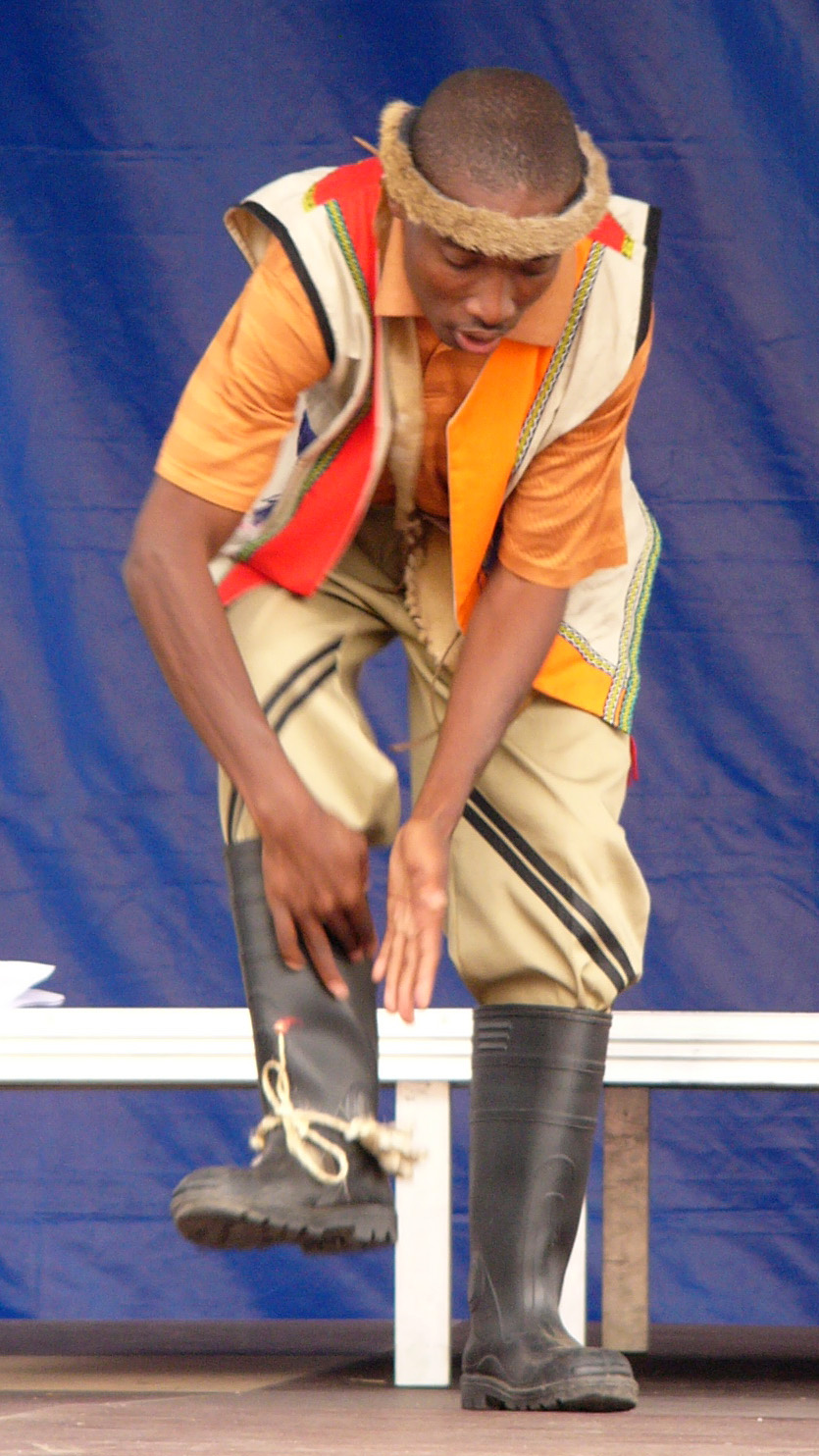
Issue 54: Gum Boot Dancing

I had never heard of Gum Boot Dancing, but it is for real! Here is a picture from the wikipedia entry:

File:Bootsa.jpg

and I quote (from wikipedia) http://en.wikipedia.org/wiki/Gumboot_danceFile:Gumboot dancer.jpg

“Gumboot dancing was conceived by black miners in South Africa as an alternative to drumming—which authorities restricted one of the other reason for gumboot dancing was for the miners in south africa as they worked they sang. gumboot dancing has now become a worldknown dance,in schools kids perform the dance. The boots were a solution to a problem of often flooded gold mines in which men otherwise stood in knee-deep water toiling at their work stations.”


I discovered gumboot dancing from this resource, which has sibelius and pdf notation for a gumboot dance. I love the idea of adding bells to the boots, and creating secret codes from the steps and rhythms.

http://www.teachingmusic.org.uk/story.aspx?lngStoryID=14638


Posted in Djembe, Resources, The organised teacher | Tagged , , , | Leave a comment

Issue 54: Dyslexia and Music Teaching

I have taught piano to a couple of pupils who were “properly”, ie diagnosed, dyslexic. One of them only continued for a couple of years. She was about 7 when she started, as was my first encounter with dyslexia. Reading the music was an issue, to be sure, but low self-esteem and zero confidence were clearly the main factors affecting her progress. Slow, mini-steps forward, lots of playing by ear and rote learning were the key. The Big Discovery came when she triumphantly managed to play “I Saw Three Ships Come Sailing In” from the Pianotime Christmas book, but was unable to read the title of the carol. We both had a good laugh when I pointed out that her school teacher would be able to read the words, but would also be totally incapable of reading the music. This was a long time ago now, and I was still as much of a beginner piano teacher as she was a beginner student.

Since then she has finished secondary school (winning a prize for English along the way) and the last I heard of her, was that she had finished college and found a good job.

Later, I started teaching a lad who was dyslexic, dyspraxic, and knew that he had problems with sequencing and understanding instructions. He was also extremely bright, and already a very competent saxophone player. He used to arrive at the piano like one of those incredibly bouncy superballs; ricocheting off the walls, crashing into the door frame, landing on the piano stool like a whirlwind and still in motion several seconds after apparently sitting down. It was like trying to teach someone whose brain was full of exploding fireworks.

In the second or third lesson, I started off by both of us sitting completely still and silent for 30 seconds “to let all the neurons in your brain settle down” (I have no idea if that phrase contains any scientific truth). At then end of this time, he announced in a thoughtful voice “I don’t think I have sat so still, and for so long ever in my life!”. The subsequent lesson was much more productive, and we used this as the opening for several months. He was a skilled learner, and often I would spend a short time going over a phrase, and leaving him to sort out how to learn it, as my attempts to teach him seemed to cause more confusion than clarity.


With both students, a key concept was to identify repeated phrases, and flag up similarities and differences. Explaining why the phrases were similar but different helped enormously eg ending with THIS note so that the tune could move into a NEW phrase/direction.

He eventually reached Grade 8 piano, having already passed his Diploma on saxophone, started a band which played in several pubs in the area, and went on to study music at university.

Here is a link to a comprehensive guide to teaching music to students with dyslexia. I wish I’d been able to read it BEFORE learning to teach the two students above!

http://rhinegold.co.uk/downloads/magazines/music_teacher/music_teacher_guide_music_and_dyslexia.pdf


Posted in Piano, Resources, The organised teacher | Tagged , | Leave a comment