27/60 Active Repertoire

A recent post on www.pianodao.com reminded me that I had meant to do something about “active repertoire”

If you go here;

https://pianodao.com/2017/10/29/christmas-repertoire-sheets/

you can read all about it, and track back to the first post on this subject. The idea is that everyone,  – that is you, and your students, should have a couple of pieces which can be performed confidently, without music, at the drop of a hat, anywhere, any occasion.

So much of what we are learning is “in progress” and therefore not ready for a public outing.

I remember, when I was about eight, the rather old-fashioned and intimidating father of a school friend insisting that I should have a “party piece” to be able to perform on demand. “Mine’s the ‘Cake-Walk’ by Debussy”, he announced, and promptly sat down (at his beautiful Bluthner grand) and played it. “Now, what can you play,” he asked? and I legged it – too shy.

Now I usually play “Solfegietto” by C P E Bach in these kind of circumstances; short and flashy. or Kabalevsky “Little Story” from his Children’s Pieces if something more cantabile would be more appropriate. It doesn’t want to be too long, or too “intellectual”, or too stressful for the performer or listener. They don’t really want ten minutes of Beethoven’s Moonlight Sonata, whatever Lucia  in the E F Benson books thought;

-from “Queen Lucia” by E F Benson;

…Perhaps as they softly assembled for departure, a little music would be suggested to round off the evening, and she saw herself putting down the soft pedal as people rustled into their places, for the first movement of the “Moonlight Sonata.” Then at the end there would be silence, and she would get up with a sigh, and someone would say “Lucia mia”! and somebody else “Heavenly Music,” …

My grandmother’s 90-year-old piano teacher, when I visited her back in the 1960s, taught me to pick out “God Save The Queen” on her ancient upright (I think she might have said “God Save The King”!) because “you never know when you might need it”.

As a priority, I shall make sure that everyone can play a minimum of “Happy Birthday”, a Christmas carol, and one of their old pieces by the end of this half of term. Starting with me.

Poppy divider

Posted in The organised teacher | Tagged | Leave a comment

26/60 Curriculum from Civitas

I discovered this free download via tracking through a long series of teaching blogs – you know how it is – one thing leads to another….

There is this series of books, one for every Primary School year;

Product Details

which lead me to the associated website

www.coreknowledge.org.uk

which lead me to this page;

http://www.coreknowledge.org.uk/curriculum.php

with this pretty diagram

coreknowledge

and by clicking on the MUSIC heading, I arrived at a downloadable PDF which you can go straight to here

http://www.coreknowledge.org.uk/CKSequenceUK_Music_Entirety.pdf

It is a comprehensive curriculum for primary school music teaching, last revised 2014. (If you click on a violin, you get just the music curriculum for that year). I’m not saying I shall follow it exactly, but I have found it very informative and will certainly take note of the ideas and suggestions.

I image quite a few of the class teachers will already have copies of the books in amongst all the other stuff in their resources cupboards; that’s high on my list to investigate when half term is over, as there are also a goodly number of teaching activities, some of which you can see on the main website.

birds on a branch divider

Posted in Class Teaching, Resources | Tagged | Leave a comment

25/60 Manuscript Tape

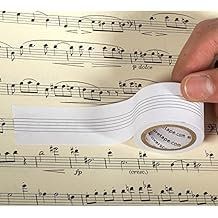
I’ve just bought myself a little roll of stick-on, peel-off manuscript tape;

Product Details

(image from amazon, but I bought mine from www.musicroom.com for £5.99 – a bit cheaper than amazon)

It was one of those sorts of things you add to an order to get the free postage, but then turns out to be surprisingly useful.

I am a dab hand at drawing freehand straight-ish lines to create manuscript paper in the margins of sheet music, or in practice notebooks, so the tape wasn’t a totally necessary item. But the idea of using it to simplify a bar (say, when the ornaments need writing out, or a chord needs re-arranging because of the stretches) struck me as being Really Useful.

It is also worth it for the “bling” factor – young pupils are dead impressed when I tear off a few inches and stick it into their book.

leaves divider

Posted in Resources | Tagged | Leave a comment

24/60 Using “this” to teach “that”

I’m currently teaching a whole class year 3 classical guitar group.

Kids playing guitar. Licensed through creative commons.

https://makemusiceveryday.com/category/social-learning/

That’s 30 children, sitting on chairs in three rows in the school hall, each encumbered by what looks like a guitar the size of a baby whale balanced on their lap (why haven’t we been allocated half-size guitars?).

Image result for child with huge cuddly toy

The question is, what funky music can I offer them while they are in the early stages of going “ping, ping, ping” on the high “E” string, or on the next “B” string?

Cue my “Red Hot” treble recorder tutor book with lively backing tracks! Once I had taught a rhythm by rote, we “pinged” away merrily, and with increasing skill and unity, to the first track on the CD. I was overjoyed to see some enthusiasm, and hear cries of “again, again”.

Next, the perennially favourite, brilliant “Glory B”, first track from my “Red Hot” descant tutor book. Superb for teaching “walking fingers” – the instrumental part is just “B B B B sh sh sh sh” repeated eight times. I’ve used this track for recorders (obviously), keyboards, and now guitars. “again, again” – music to my ears. The whole bar rest is just enough time to call “girls” or “boys” or “front row” to add variety and challenge.   Capuchin plays the recorder

More and more, I am using the tutor for one instrument to teach another – have you tried using the “Recorder Magic” interactive DVD (my “go-to” all-time favourite whole-class recorder teaching resource) to teach keyboards, pitch notation on boom-whackers, or ocarinas? Oh, you should!


Posted in Class Teaching, Guitar, Learning, Lessons that have happened | Tagged | Leave a comment

24/60 The Benefits of Teaching by Numbers/Letters

What!?! I hear you cry. Wasn’t the last post a diatribe against exactly this idea?

Err, but nothing is quite as black and white as it seems. For example, teaching little five-finger warm ups (here I am wearing my pianist hat again, but I am sure other teachers can adapt this.

One of the main many aims of instrumental teaching is developing independence and strength in fingers.

what is easier for a beginner to read? 1 2 3 4     5 4 3 2    1 2 3 4     5 4 3 2     1  or the notation?

Or    1 2 1 2 1       1 3 1 3 1        1 4 1 4 1        1 5 1 5 1  (while rapping “I like chocolate cake” or similar)

Or inviting children to make up their own “telephone number twisters” using the numbers 1 2 3 4 5

Or, at the end of their first term, when note reading is still in the early stages, teaching them

3 3 3     3 3 3     3 5 1 2  3        4 4 4 4     4 3 3 3     3 2 2 1    2      5   so that they have something to play on Christmas Day?

Or chanting E D C      E D C       CCCC   DDDD   E D C     while playing Hot Cross Buns?

Or improvising a tune using words like   EGG   CAB    FEED     BADGE as a starting point?

and look what I have just found….http://musicmattersblog.com/2006/11/27/a-music-spelling-bee/

We are engaged in the complicated process of connecting eyes – reading music, brains – processing the symbols on the page, muscles – activating the required fingers, ears – hearing the sounds, all at the same time. And, all at this same time, we want the experience to be enjoyable and successful and satisfying for the student.

It is well worth using every avenue that will lead to developing these skills! (But I am still a bit of an obsessive about learning to read music!)

 aliens for treble recorder     aliens for the descant recorder     aliens for clarinet players

Posted in Learning | Tagged | Leave a comment

23/60 Teaching by Finger Number/Note Letter

Please don’t.

I think it is is such a BAD idea…

What has provoked this post, is taking on a number of young piano students recently. They turned up with numbers written over EVERY SINGLE NOTE in their pieces. Ugh. So, they are playing fairly fluently, but with no sense of rhythm or pulse. They are also doomed every time there is a position change or shift in hand shape.

I’m talking about piano pupils, approaching Grade 1 stage, but I have seen the same with string players – every note labelled with string letter and finger number, so “Twinkle Twinkle” looks like this; (for a cello player)

D0 D0 A0 A0 A1 A1 A0 D4 D4 D3 D3 D1 D1 D0 etc

for a pianist it might look like this; 1 1 5 5 5 5 5 4 4 3 3 2 2 1, and if the pupil hasn’t realized that 5s refer to note G G A A G then the numbers are not going to work.

I dare say there is a way of writing numbers for other instruments as well.

You end up with pupils who cannot learn a new piece until it is fully numbered and lettered. This is such a bad foundation for the future. I used to have the same battle with young recorder groups. Having painstakingly taught them the note B, “bang on the middle line” and the note A “in the spAce” – how hard is that to learn? Per-leese? – they come back next week with every single letter written in. Being the mean and horrible person that I am, I promptly rub out all the letters.

OK, I’m not that mean. When a young piano pupil came to me with “Mary Had A Little Lamb” completely lettered and numbered – “Mummy did it for me”,

mary had fingers and numbers

I started by discussing whether the repeated EEE, DDD, EEE in bars 2,3 and 4 all needed to be written in.We agreed I could rub out the duplicated letters. Then I wondered if she would still be able to play it if we rubbed out all the middle Cs. (“The notes with whiskers on their faces, like C for Cat”). “Maybe…”, so I handed her the rubber. By stages, we worked out that even if we rubbed out all the letters, she could still read the notes – Whoop whoop and three stickers!

My policy is to resist all attempts to add extra letters and fingerings, and I use every opportunity to sneak in some no-pressure note reading practice. Like….

“Play me just the Ds in this piece, as I sing it to you”

“Point to all the Fs”

“How many times do you play Middle C”

Well done – have another three stickers! (and give one to yourself for being such a brilliant teacher!)

Wait, now, I’m just remembering the the number of times I use “telephone numbers” and “spellings” to teach tunes… here comes another post…

birds on a branch divider

Posted in Lessons that have happened, Practising, Theory | Tagged | Leave a comment

22/60 Finger Puppets

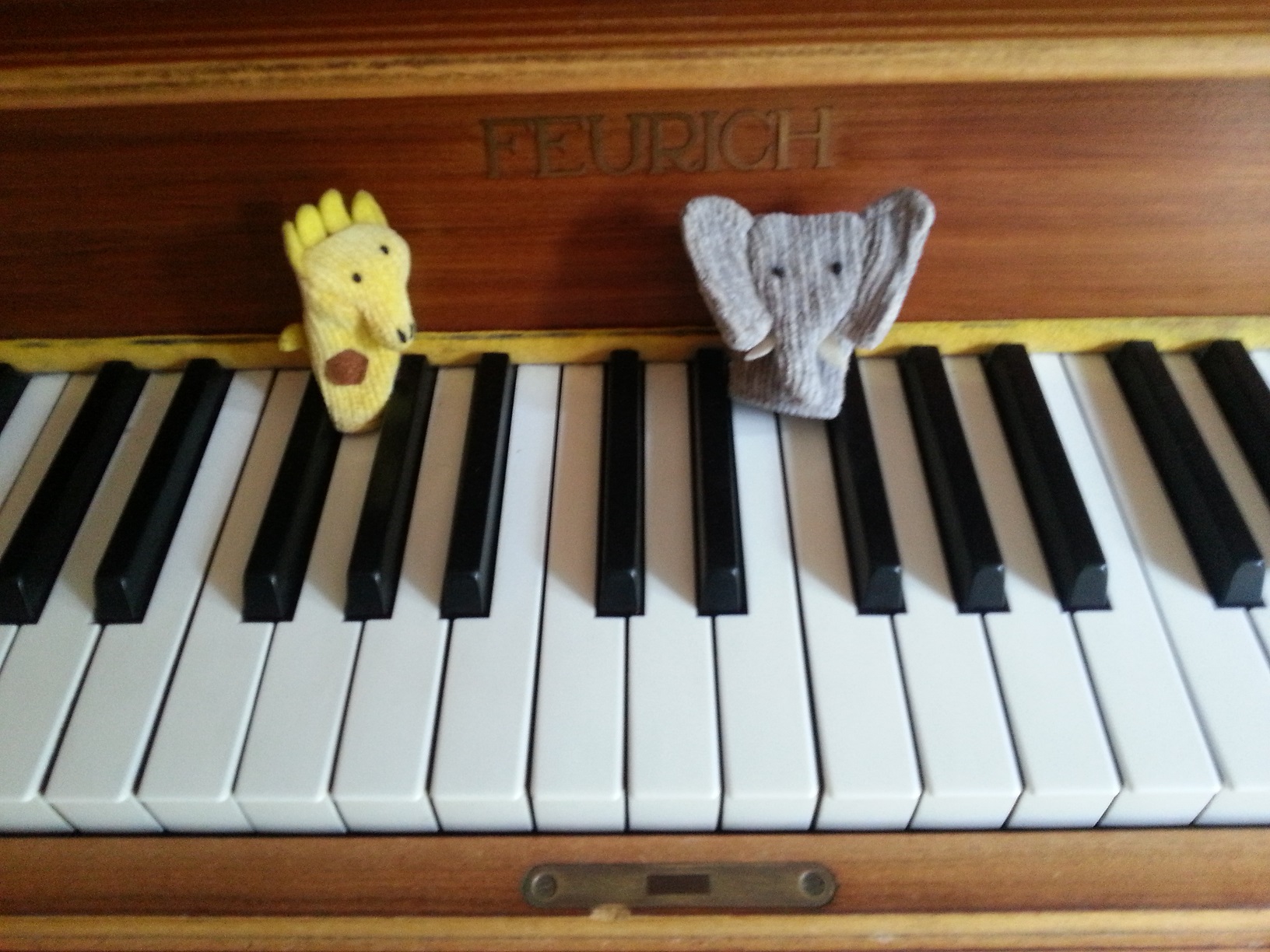
I have two – an elephant and a giraffe – and they usually get involved in piano lessons most days.

elephant and giraffe half size

Sometimes I wedge them on the keyboard to indicate where E and G are, and other times they sit as an encouragement while a young student plays, or an inducement (let’s have a go at “Flying” and then the elephant can come out and play).

Sometimes I hide them under my fingers as I play, making my fingers arch over the animal like a safe cave, to demonstrate a natural curved finger shape. My thumb is then like a door at the front of the cave.

I’d love to have complete set of finger puppets, maybe an Antelope, a Bear, a Cat, a Dog and a Fish, to keep company with Elephant and Giraffe. One for each note! If I had enough patience, I would knit myself a set. But I don’t.

Well, just maybe, my wish will be coming true… I’ve ordered a set of 10 finger puppets from Amazon costing a mere £1.83! How on earth can they make and pack and ship finger puppets across the world for less than £2? Obviously, in order to avoid paying postage I’ve had to find something else to buy for at least £8.17, but that wasn’t too hard.

I’m waiting hopefully for the puppet’s arrival in the next day or so – I’ll let you know what they are like.

Posted in Piano | Tagged | Leave a comment

21/60 The invisible pencil

It’s not the pencil that is invisible, come to think of it – the title is a bit misleading.

I’ve inherited a number of young piano pupils who are very weak at note-reading, so the challenge is to encourage them to engage “their little grey cells” and start learning their notes on the stave rather than relying on fingering and notes written in.

Actually, the challenge is for me, to keep on encouraging them to read the music. It is just too tempting to write in fingering and note letters from a mixture of exhaustion and exasperation.

We were going through the first piece in Book 5 of the Lang Lang Piano Method, a series I have just started using and am increasingly impressed with. The left hand of this piece is a cleverly constructed simple repetition of a scale element, with different endings each time.

“Could you just write an ‘F’ by that note so I can remember it?”, she asked sweetly. I swear she had her head on one side and was using a winning smile.

Image result for peanuts lucy images

I held the point of the pencil a millimetre above the point on the page, and mimed writing ‘F’.

“I suppose that means you won’t write it for me,” she said in a disappointed tone of voice.

Image result for peanuts lucy images

“No, no, I have written it in, but using invisible writing.”

Image result for peanuts lucy images

I got “the look”, but somehow she has managed to remember the ‘F’ and play it every time. Not sure how many times I can play that trick, though.

contrary motion divider

Posted in Lessons that have happened, Piano | Tagged | Leave a comment