20/60 Tears in my eyes

Last week I started about six brand new beginners, all aged between 7 and 9, who had never had a piano lesson in their life before. And in each of these lessons I had to brush away a little tear. Honestly. At my age. I’ve been teaching the piano for maybe twenty-five years, and it gets me every time.

In that precious, first half an hour, I covered

  1. how the black notes are arranged in groups of twos and threes (and we “splatted every group)
  2. high and low, loud and soft
  3. ‘D’ for dog is found in the dog kennel made by the group of two black notes (and we found every dog)
  4. ‘D’ is written like a ‘d’ (so we wrote music with minims and crotchets)
  5. ‘C’ is like a dog, but with whiskers ‘d‘  (so we wrote music for cats and dogs)
  6. ‘B’ for bear, or bee – depends on the child – is written like a ‘p’ (so we wrote music for bears and dogs)
  7. And now you can read the first page of the tutor book (in this case ‘Get Set Piano Book 1’)

And then I found a hanky and cleaned my glasses. Each and every child was awed by their achievement, and, with a little help, or in some cases no help at all, played the first couple of B and D pieces with increasing amazement.

I’ll go back over the details next week – you know, rhythm and counting and staves and treble clefs and bass clefs and all that malarkey. The important thing is that they left the music room reading and playing music, with plenty to keep them going for the rest of the week.

This is why I still teach piano after twenty-five years.

Oh, and if you were wondering why the posts are numbered in such a weird fashion, I am challenging myself to get 60 posts up before 31st December, so make up for my ‘sabbatical’ earlier this year.

Snake keyboard divider

Posted in Piano | Tagged | Leave a comment

19/60 Wobbly Chicken warm up

http://headsoccer.wikia.com/wiki/File:Wobbly_Chicken.gif

http://headsoccer.wikia.com/wiki/File:Wobbly_Chicken.gif

Click on the chicken to make it wobble…..

I have led two singing assemblies now. The first one got off to a great start using the 5 second shower . The second was started by another teacher, who was going to teach a call and response song for the Harvest Festival which is looming all too soon. He did a sort of verbal warm-up along the lines of

“are you ready to sing?”     “yes”

“are you READY to sing?”   “yes”

“Are you REALLY READY to SING?”     “Yes”

But I wasn’t convinced. So, interrupting before he could start singing, I got everyone to stand and demonstrate the five-second shower – which hugely transformed the mood and energised the children.

I can’t keep on showering before every assembly, so here’s another tried and tested one;

For a count of 1 2 3 4 5 6 7 8, shake first one leg, then the other, then one arm, then the other. Repeat, for a count of 4 each, then 2 each, then 1 each, then crouch down and spring up into the air while calling

“w–o–b–b–l–y–c–h–i–c–k–e–n!,      starting with a low pitch voice, rising  in pitch as you jump.

You can repeat this, doing the counting in your “thinking” voice, which has a sort of surreal effect.

leaves divider


Posted in Class Teaching | Tagged | Leave a comment

18/60 The five second shower

https://www.flickr.com/photos/shanlung/2991809542

https://www.flickr.com/photos/shanlung/2991809542


Here’s a physical warm-up we learned on our training day last week;


The Five Second Shower

hold a pretend bar of soap in on hand, and rub your hands together as though you are making a lather

while you are doing this, explain that you are about to take a 5-second shower, starting at your head and working down to your feet. In order to make sure you take just five seconds, we will count down backwards.

Ready?       Go!      5 (head)   4     3     2     1 (feet)

Okay!       Start “lathering” again, while you explain that you are going to do a 4-second shower.

Ready?      Go!      4 (head)   3     2     1 (feet)

I expect you can guess what comes next – the children in my singing assembly could certainly work it out! You end up with a manic 1-second shower.

A bit of buzzing, a bit of sirening (singing on the sound ‘ng’ up and down in pitch), a bit of listen and copy, and we were ready to sing! The shower certainly created an energised feel to the start of the session.

birds on a branch divider

Posted in Class Teaching | Tagged | Leave a comment

17/60 March to the Beat

I learned this activity at a training day earlier this week, and have been trying it out yesterday – three times! With year 1 (just 5 of them, as reception had already gone home), a year 3 and 4 class, and a year 5 and 6 class.

It is deceptively simple – you play a walking beat on a drum (or, in my case, a woodblock) and the idea is that the class walks round in time to your beat, stopping when you stop, starting when you start. You’d be surprised; we found it easy on the training day, but we are all grown-up professional musicians. Even making allowance for the natural exuberance of small children released to move around in a large space, it took a while for them to settle into the beat.

I introduced the activity while the children were sitting in a circle. I played a steady beat and walked round in time, stopping and starting and asking the children what I was doing.

Of course, these are crotchet beats, a musical fact I will be introducing later.

Then, you introduce “jogging” – quavers – (which is NOT the same as running, Liam and Percival). This can (and briefly, did, with the older children!)  quickly degenerate into crazy running round unless you are ready for this. I found lashings of praise for the children doing really neat jogging, especially if they were “pack-leaders” did the trick.

Once it was going well, I let the children take a turn at leading, setting them up for success by announcing that I was looking for really good followers to be the next leader.

Finally I dished out claves, wood blocks and rhythm sticks to everyone, and asked them to play in time with me, watching and following exactly what I did (“watch out, who is a really good follower?”)

One more class to try it with – a year 1 and 2 class this afternoon.

It is a surprisingly tiring activity – mentally – as you need to concentrate if you want to get it right.

On the training day there were further ideas for developing this very simple, but profound, activity which I’ll post in due course.

branch divider


Posted in Class Teaching | Tagged , | Leave a comment

16/60 Jazz Piano

I’m about to start teaching Jazz Piano. Again.

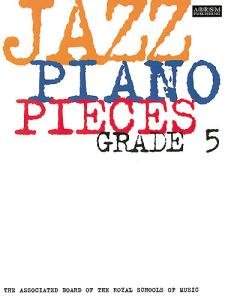
ABRSM Jazz Piano: Pieces Grade 5

Now here’s an admission – many, many years ago, I did teach the ABRSM Jazz syllabus. I had a Grade 1, and Grade 2 and a Grade 3 pupil, and at the same time I entered myself for a Grade 4. Why enter myself?

Well, this was completely new territory for me. I had a copy of the ABRSM book “Jazz From Scratch” by Charles Beale which I had a good look at, and then I bought some of the exam material. (Regrettably, I lent my “Jazz from Scratch” to a pupil and it has never come back. Ho Hum. I could do with it now.) I remember starting with Grade 1, happily chuntering through the first page, and then, on page two, the notes in the right hand all disappeared to be replaced by the words “8 bars improvisation”.

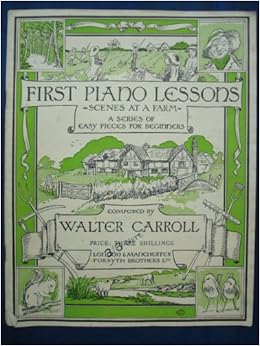
You have to remember that I started piano lessons when dinosaurs were still roaming the land, and one played Czerny and Walter Carroll and Mozart and Bach and, maybe, occasionally, something very weird like Bartok.

Image result for scenes at the farm

Yup – this is just how I remember the cover.

So, back to me and page two of Grade 1 Jazz piano. I poured a glass of wine, had a go at interpreting the chord symbols (they didn’t write them like that in my theory classes) and set to work. It took a couple of evenings before I got the rough idea – and a bit longer before I worked out how to “teach” improvisation – a skill I had never explored before.

I can’t have been too bad – we all passed with better or lower scores, reflecting how much practise we had done, how well we had learned our scales and what we were like at sight reading.

I entered myself, because I wanted to know exactly how the exam, especially the aural section, was delivered, and I wanted to have a clear idea of how the comments reflected what the candidate played. I’ve plenty of experience of classical exams as candidate and accompanist. I’ve even taken music exams as an adult of maturer years; my teaching Diploma (LTCL) and Grade 5 singing, and even, in a mad moment, Grade 1 violin!). So I can be confident that I can translate the examiner’s written comments into what happened in the exam room, even when I wasn’t there. It is a different experience. There is a lot of improvising, in all three pieces, and even in the sight reading and aural tests.

The scales are “weird” too; I developed a sort of short-cut to learning them which meant that I could rely on my classical major/minor knowledge to save time in learning them. The fingering can go a bit wild if you aren’t paying attention;

mixolydian means “minus one, or one accidental lower” eg C mixolydian is C-with-B-flat

dorian means “double-delete” eg C dorian is C-with-E-flat-and-B-flat

lydian means “let’s have another accidental” eg C lydian is C-with-F-sharp”

aeolian means “in the minor key-signature” eg C aeolian is C-with-B-flat-and-E-flat-and-A-flat

I admit, I kind of winged it through the syllabus first time around. This time I aim to do better. For starters, as part of developing my skills at reading lead sheets, I am going to mug up on the chord notation properly. Maybe I’ll even attempt Grade 5… More of this to come!

branch divider

Posted in Piano | Tagged | Leave a comment

15/60 Free Song Source

Some time ago I came across this site;

www.vocalunion.org.uk

I’ve copied and pasted this from the home page which explains who they are and what they are about:


sage

This website was initially created to provide resources for the Vocal Union project. All materials on the site are freely available to people working in community music and education.
We gratefully acknowledge financial support from the Sage Gateshead and Sing Up.
The site is currently hosted in collaboration with BlueJam.


It is a treasure-trove of lovely songs for all ages. I’m about to start running the singing assemblies at one of my schools this term and I can see that I’m going to include a few of these. Like this one, which looks like a nice little warm-up, and might even find its way into the Harvest Festival. Happy singing!

Bela Mama

http://www.vocalunion.org.uk/vocalunionpdfs/Bela%20Mama.pdf


leaves divider


Posted in Class Teaching, Resources, Songs | Tagged , | Leave a comment

14/60 Lead Sheets and Piano Lessons

https://en.wikipedia.org/wiki/Lead_sheet

At the music service that I work for (when I’m not working for other schools or as a private teacher) we have been revising the piano curriculum that supports and underpins what we teach. For the first time, teaching the pupils how to read lead sheets has been incorporated, starting from around pre-grade 1 level. In the early stages we just get the pupils to play a simply accompaniment to a melody using the chord symbols, while I play the melody, working up to more complex chords and “hands together” as they progress.

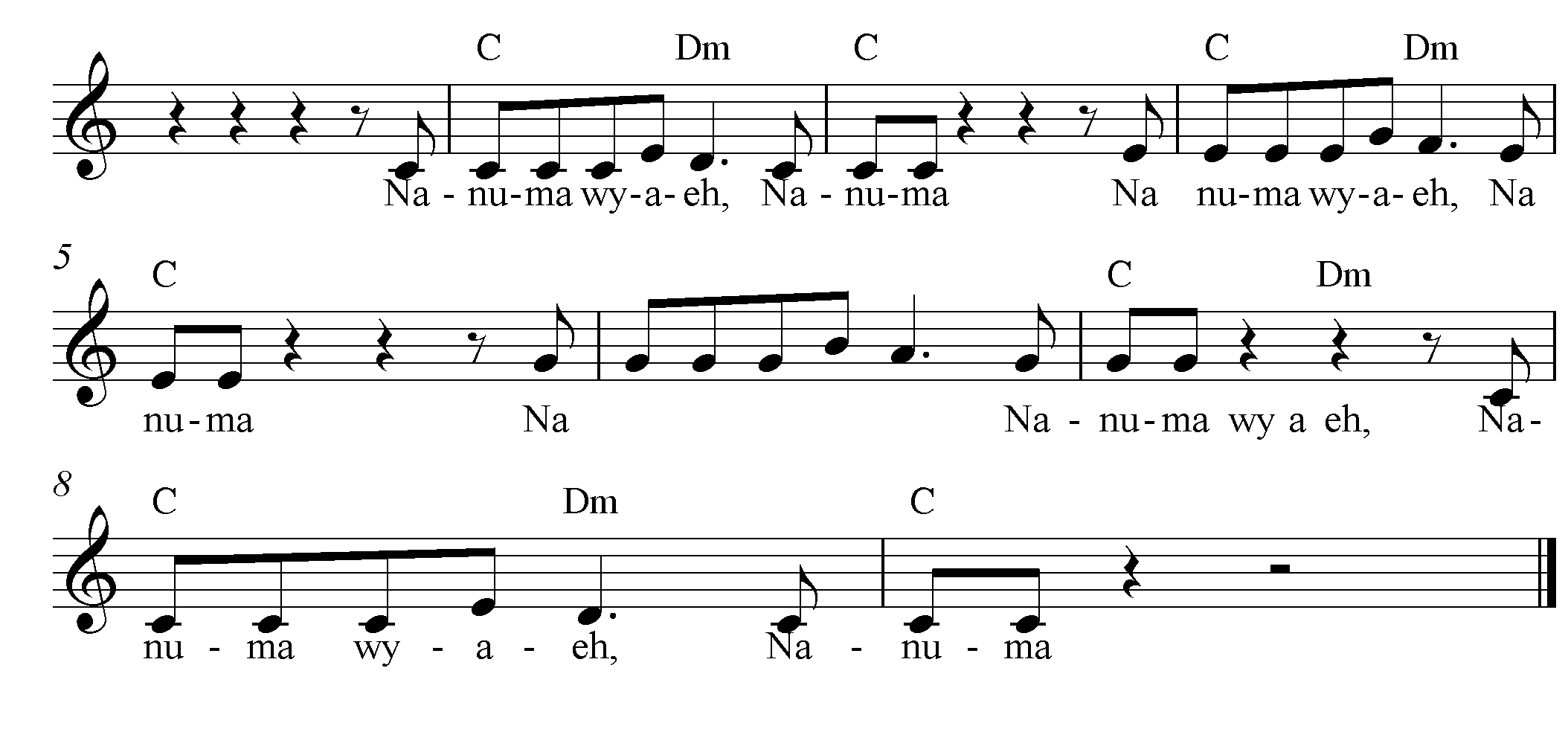
I’ve added chord symbols to many of the easy songs that I use in music lessons like this;

nanuma-melody

so I think these will help me get started. I’m also going to browse through www.teachpianotoday.com which has a lot of blog posts and ideas to get me started.

Snake keyboard divider


Posted in Keyboards, Piano | Tagged | Leave a comment

13/60 New Term, New Start, New Post

I vaguely remember stating that I would attempt to do 60 posts this year – but I appear to have had an unintended Music Jungle sabbatical for several months.

willy wonka quote

Right – let’s do some sums; there are seventeen weeks left in this year before the start of the Christmas holidays. So, three or four posts per week should see me on my way to managing a total of 60. Let’s go!

I have signed my school up for http://www.classicfm.com/classical-100/full-list/ which is a list of 100 pieces of classical music that you can stream. It’s been around for years, but somehow I never got around to exploring it

classical100 resized

My new resolution for this coming term is to try and get the class teachers into a mindset of playing music to their classes every day, and this app might be just the way to encourage them. It has been developed by ABRSM (Associated Board of the Royal Schools of Music) and ClassicFM. You can select music by instruments, mood, period, nationality and other things that I can’t begin to remember. There’s a really good variety of old favourites and less well-known pieces; well worth a look. Or rather a listen.

Schools can register for unlimited access to Classical 100 at www.abrsm.org/classical100.


birds on a branch divider

Posted in Class Teaching, Listening Music, The organised teacher | Tagged | Leave a comment