Issue 62: P D Q Bach

I came across the “New Horizons in Music Appreciation” a few years ago, when a friends played me their CD. This is Beethoven’s Fifth symphony(first movement) with a base-ball match-style commentary, which, incidentally, is a pretty good analysis of its melodic construction! I did not realize that it was one of the notorious P D Q compositions until recently. Today I have ordered the CD set “The Wurst of P D Q Bach”,

The Wurst of P.D.Q. Bach

and I am hoping it will arrive over half term. I have a serious list of domestic chores to get through, and I reckon this should help make light work of heavy going.

Posted in The Jungle | Tagged | Leave a comment

Issue 61: Welcome to the Jungle

This week there is a new action game I came across, and a an outline of this half term’s lessons with a year 1 2 class all about instruments, and the Three Little Pigs. I have also jotted down a few comments on how I manage recording the children using my laptop.


Posted in The Jungle | Leave a comment

Issue 61: Recording in music lessons

Technology is a wonderful thing, when it works. As in easy-to-use, reliable, fool-proof. Especially fool-proof!

I am lucky enough to have a laptop with a quite a good inbuilt microphone. This makes it easy to record bits of lessons without having to do much in the way of setting up. The little microphone icon sits on the desktop, so it is a simple matter to click on it, and I have also got a short-cut to the folder where microphone recording get saved to, for ease of playback.

Once the laptop is “up”, all I have to do is click on the icon and we are away. I save the recording as something quick, like 111, 112, 113,  etc in the lesson for speed. I then rename the files afterwards with the school and class and subject later while I can still remember what they are.

All children love hearing their music played back, and keeping the recordings, with notes on the context, provides a record of work.

Posted in The organised teacher | Tagged | Leave a comment

Issue 61: The Three Little Pigs

This half of term I have been looking at “timbre” with a year 1 and 2 class, working towards performing a “musical” version of the Three Little Pigs. This fitted in nicely with their class topic of “Traditional Stories”. We also managed to connect with their literacy unit on “Writing Instructions” along the way.
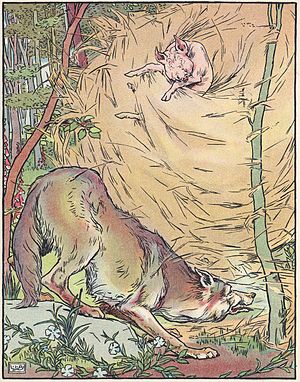
The wolf blows down the straw house in a 1904 adaptation of the story. Illustration by Leonard Leslie Brooke (wikipedia)

Every lesson also started with a movement activity, either linked to listening to some music and moving expressively, or a singing game.

Here is a write up of the lessons as a mixture of fact and fiction: what did happen, what could have happened, what should have happened as a starting point for anyone who would like to try and create their own version.

Week 1

I took quantities of three or four categories of percussion, so that I could divide the class into several groups of similar instruments. For example, shakers, tambourines, claves (sticks), jingle bells.

I demonstrated each instrument, discussed the “right” way to play (carefully, not banging them on the floor, watching what you are doing), and we talked about the sounds they made.

The instruments were handed out (“and when you get your instrument, you will put it on the floor in front of you and NOT play yet”) and then we played together, keeping the beat in time to a song, or taking turns (“just the jingles this time”)

Week 2

The same selection of instruments, and roughly the same process. This time the children were asked to arrange themselves into instrument groups, and the idea of “conducting” – hand signals for which group should play when, and louder and softer, introduced.

Week 3

A more varied selection of instruments was used (but avoiding the really “exciting” big drums, steel pan, giant cymbal for now!). The idea of notation, using whiteboards and pens, was introduced (a cross for claves, circle for tambourine, etc). Children followed the signs on my whiteboard, and then were paired off, with two different instruments and a whiteboard each to notate and play their own music. As I went round all the groups, I encouraged them to consider elements such as loud and soft, fast and slow, and find ways of notating them.

Week 4

The wider selection of instruments was brought in, and we discussed what they were made from, and described the sounds. The children grouped themselves according to different categories: wood, metal, something else; or loud, soft, both loud and soft, for example. There was more conducting to compare the different effects of different groups.

At the end of the lesson, after the instruments were put aside, talked about the first part of the “Three Little Pigs” and which sounds would work for straw, sticks and bricks.

Week 5

Now that the children were settled into the term, and I knew most of their names, and had a rough idea of their behaviours, I felt ready to risk the really exciting percussion. So we emptied the cupboard; the children took slit drums, an old guitar, the Big Cymbals (and a soft stick!), xylophones, mini steel pan, the giant bass chime bars –  in fact every sound-maker that wouldn’t be too heavy for them to carry.

Each instrument was played and discussed in turn, and then all the children had an opportunity to play everything (it was a very noisy lesson). I took the view that the children were all desperate to play all the instruments, and it would have been very hard for them to have a sensible discussion when their hearts were yearning to have a go at the Really Big Cymbal. A bit like holding out a biscuit

We did manage to leave enough time to play all the instruments again, one at a time, and describe the sounds some more.

Week 6

Back on track for the “Three Little Pigs”. I had written a little nursery-song style verse for the story, and sang it to them, recording myself on my lap-top in front of their eyes. Bonging a “C” chime bar four times makes a useful and easy introduction, and I have includied an optional chilme bar part under the words. I would have taught the song, and used it, earlier in the term, but I hadn’t thought of it then. The children were fascinated and absolutely silent for the recording and playback, and very enthusiastic about the idea of learning the song and being recorded. When they were singing it confidently (after about three verses, it is that simple!), I recorded and played back their singing.

We were now ready for the grand performance. I sorted out the groups for straw, sticks, bricks, the sound of the wolf “huffing and puffing”, the sound of the house falling down.

We discussed the requirement for silence when recording. I even went as far as recording us all being silent, and playing it back. Every last jingle, thump and shuffling noise was there for everyone to hear, and we agreed that we would have to be Very Careful during the recording!

Part 1 used the song, and the groups playing straw, stick and bricks music, directed by a conductor. I stopped the recording and played it back.

Part 2 was briefly rehearsed, before being recorded. It consisted of half the class playing the wolf “Little Pig, Little Pig, let me come in”, the other half playing the pig “No, no, by the hair on my chinny chin chin”. “Then I’ll huff and I’ll puff and I’ll blow your house in”. The huff and puff sounds followed (rainstick) and the crashing of the house (Really Big Cymbal)

Part 3 was a “vocal sounds” section; as I narrated the wolf going down the chimney, landing in the fire, and shooting back up and away, the children made appropriate sounds, following hand signals.

Posted in Lessons that have happened, Lessons that might have happened | Tagged , , | Leave a comment

Issue 61: Diddle Diddle Dumpling, My Son John

I learned this game from a colleague on Wednesday, who had learned it from someone else on Tuesday. I taught it to another colleague on Thursday……

Iraqi Jewish kubbeh (wikipedia)

Diddle diddle dumpling, my son John

Went to bed with his trousers on

One shoe off and one shoe on,

Diddle diddle dumpling, my son John.

You can find other versions of the rhyme, download sheet music and read some historical background here: http://www.mothergooseclub.com/rhymes_parent.php?id=153

The words are a traditional nursery rhyme which I have known all my life. The actions were new to me:

Did-dle did-dle dump-ling – pat each knee in time to the syllables LRLRL R

My son John – touch head for “my”, shoulders for “son” and knees for “John”

Went to bed with his – no actions

Trou-sers on – clap on “trou” and “sers”, and then palms out to centre (as though patting a friend’s hands) at “on”. With younger children, we just clapped three times.

One SHOE off and one SHOE on – stamp one foot on SHOE, and the other foot on the other SHOE

Did-dle did-dle dump-ling – as before

My son John – as before

You then choose to omit the words of one or more phrases, but just do the actions. Eventually you perform the whole rhythm using konly the actions and no words.

These action rhymes and songs provide important practise in developing the skills on internalising pulse and melody. Some other examples that I have already posted are

“My hat, it has three corners”

“Tony Chestnut”

Posted in Songs, Uncategorized | Tagged | Leave a comment

Issue 60: Welcome to The Jungle

Friday again. It’s been a mixed kind of week for me, for all sorts of reasons, but this photograph kind of summed it up in one image:

Photo

I took this photograph of the rainbow over the school playground as the last lesson finished and the children were getting ready to go home. The over-excited stampede of one hundred year 3 children in the cloakroom area  came to an abrupt halt when they spotted the rainbow. All thoughts of lunch boxes, coats, reading folders evaporated as they jostled and exclaimed of the brightness of the colours, the dark clouds, and the clearly visible second rainbow (sadly faded by the time I got out onto the playground).

So I finished this week with renewed hope for the week to come.

Meanwhile, I have assembled this week’s jungle, comprising a brilliant resource for traditional songs, complete with video and audio, another one-chord song, and some thoughts on being a natural learner.


Posted in The Jungle | Leave a comment

Issue 60: Resource for Traditional Songs

I just stumbled upon this!

http://www.bbc.co.uk/learning/schoolradio/subjects/earlylearning/nurserysongs

BBC School Radio: Nursery songs - Old MacDonald had a farm

This is the picture for “Old MacDonald had a farm”

My word, what a great free resource! You get audio, video, lyrics, and a link to a “Sounds Stimulus Library”.

Definitely worth a visit, and not just for Early Years classes.

Posted in Early Years, Resources, Songs | Tagged , | Leave a comment

Issue 60: Learning and “the natural musician”

I’m not sure if I AM a “natural musician”.

I stand in awe of my colleagues who can play their instrument so much more fluently than me, who can hold a part, keep a rhythm all in an apparently effortless manner.

They can do that conducting thing when you draw triangles with one hand and squares with another.

They can play cross-rhythms; not just “2 against 3” (that’s not actually too hard), but “5 against 4” or “13 against  2” (I’ve been teaching Chopin).”

They can syncopate without counting all the quavers, and “feel a groove” (I’ve been teaching Brubrek).

They can identify modulations to the super-tonic minor without breaking a sweat, whether or not they have perfect pitch (I’m bracing myself for teaching grade 8 aural).

I think I am a “natural learner”. I love learning how to do things, and, more importantly, learning ABOUT how I learn things.

Not everything; I don’t want to teach myself how to use my new mobile phone, and I rely on others to do techy stuff like update the computer. I’d rather watch “The Great British Bake-off” than have a go at making the cakes.

But about music; I am fascinated by the different ways of going about learning music. Teaching and learning music is like taking part in the most brilliant treasure hunt ever contrived. The prize is being able to play something well, or better, or in a new way, whether that is for me, or for my students.

Indeed, very few of my students are “natural” pianists, but all are capable of learning, and progressing, and gaining pleasure from the sound and tactile feel of playing the piano. If I can help them on their way to this prize, then that’s prize enough for me.

Posted in Learning | Tagged , | Leave a comment