Issue 37: Welcome to the Jungle

Hello everyone, everywhere!

I have been asked to create a list of equipment that I would like to have for the school music cupboard (“but we aren’t promising to buy EVERYTHING on your list”). That set me thinking, and here’s my list for Early years / Key Stage 1. My wish list for this school enters a world of dreams at the very first paragraph; that school doesn’t have a hall. We all troop over to the village hall next door, having first stopped off at the shed in the playground to collect the instruments that I think I will need. That is, if the instruments ARE in the shed; random selections may well have relocated themselves to another classroom, or the infant’s Outdoor Play Area. I have learned to check beforehand, otherwise I arrive at the hall to find all the C chime bars are missing, or I have got triangles, but no beaters in the triangle tray!

I have written up the next chapter in my adventures with the beginner recorder class and “Pease Pudding Hot”; writing our own music, and incidentally producing your own manuscript paper in a hurry.

Finally, the Olympic feature this week covers sports improvisations. I planned to illustrate the ideas with neat little icons for each sport clipped from the 2012 Olympic website, but then I read their copyright rules and changed my mind. They also have complicated statements about whether you can link to their site. Reading through the clauses was like trying to sight read a Bach fugue using a small print edition of the music. If you would like to have a look, search for london2012 on the internet.  


Posted in The Jungle | Leave a comment

Issue 37: Music Wish-List; Early Years/Keystage 1

First of all, I’d like a really big, light, airy space. Enough room for thirty kangaroos, or lions, or monkeys, or robots to strut their stuff all at once without fear of crashing into each-other.

Which brings me to the next item; a music system which is easy-to-use and will take mp3 players or CDs without fuss. It has to be powerful enough for thirty elephants to stomp around and still hear the beat.

A large whiteboard will also be very useful. If there’s plenty of money around, then a reliable, well-maintained, well-supported (technically and structurally) interactive whiteboard and overhead projector would be lovely, but a whiteboard, and pens which actually write, will be fine. I’ll even bring my own pens, if you like!

This dedicated space would have storage for school instruments along one wall; open racks with trays in them might be best. What would be in the trays? For a class of thirty children, fifteen each of;

Shakers, pairs of claves, small tamborines, hand drums, woodblocks (the sort that can also be played as guiros or scrapers), triangles and bells-on-sticks. The nice little egg-shakers are lovely for this age group, but be aware that they (the eggs) will fit neatly and completely into their (the children’s) mouths unless you deal with that straightaway. So maybe I would choose shakers with handles and avoid this problem altogether.

(Also mini-whiteboards and pens, pencils, paper, sharpeners, erasers, and a waste bin in the corner. And a box of tissues.)

With this “basic” selection, all stored close beside me, I can choose an instrument and run the lesson, having the children share “one-between-two”, taking turns, or choose the sounds I want and be sure that there will be enough. Tidying away at the end becomes so easy – line up the children, pop the instruments into the trays as they head to the door.

The instruments above provide a lot of scope for pulse, rhythm, graphic scores, accompanying simple stories etc. To extend the variety of sounds that we can use, I would add a few “special” instruments; a large alto or bass xylophone, a couple of cymbals, some larger drums, and some unusual sound-makers, such as a rattlesnake, thunder roarer, rainstick, finger piano, and a selection of different types of beaters.

At some stage I would want to add pitched sounds, for playing simple drones and melodies. Half-a-dozen octave sets of chime bars, with plenty of extra beaters, and a couple of sets of boomwhackers would be just perfect.

Now then, why are you laughing? What’s my budget? Really? Is that all? Perhaps I’ll have to settle for some finger cymbals then. Or we can always sing and clap our hands!


Posted in The Jungle, The organised teacher | Tagged , | Leave a comment

Issue 37: Writing it Down

One of the best ways to assess how well the children are able to read music notation is to get them to compose their own music.

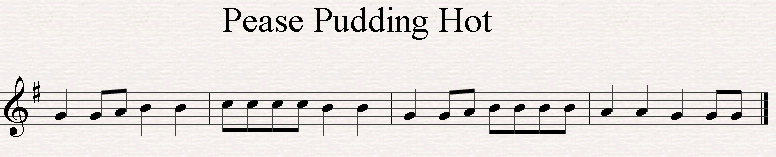
Last week, I did “mini-beasts in the Pease Pudding” with a class of year 3 beginner recorder players, reading and playing the notes G A B C and also crotchet, quaver and crotchet rest notation. This week, I revisited the same piece. I put the musicjungle page up on the class whiteboard so that they could see the original “Pease Pottage” song and the mini-beast version, and we played both, discussing the differences.

The next step was to go over how the notes are written on the stave, and write up a few phrases to copy, emphasising the position of the note heads (blobs) for each letter. At this stage I didn’t go into the intricacies of time signatures and bars – my focus was to ensure that the children could read and write pitch and rhythm notation accurately.

I didn’t use the “aliens” method on this occasion, but if “space” is your topic, this might be a good method.

There was an eager rush of hands in the air when I invited children to write a little tune for the class to play, and a chorus of disappointed “aw”s when, after just two examples, I called “time” on that activity. However, the appearance of a pile of sheets of music paper was greeted with great enthusiasm, and after that the lesson ran itself, if rather noisily.

Resources – creating MS paper for children

You can enlarge ordinary MS paper on the photocopier. Got no MS paper? To create it in Word; make a table consisting of four rows and one column, make sure that “spacing” is set to “No Spacing” and the font in the table is 5. Copy and paste the table down the page.

Always remember to ask “Why should we always use a PENCIL when writing music? Why is a pen a Very Bad Idea?” before handing out the paper….

The children settled down to writing and playing their own music, and I circulated. I was able to spend a few minutes with each child, encouraging them along, playing what they had written, and explaining exactly how to place the notes in the couple of cases where they obviously hadn’t understood the relationship between position on the stave and fingers on the recorder.

Once the initial enthusiasm had died down, I suggested that they play each other’s tunes, which lead to a renewed frenzy of writing and playing.

It was lovely to see how these scraps of paper were saved and treasured to be taken home to show to their parents.

Posted in Composition, Lessons that have happened, Recorders, The organised teacher, Theory | Tagged , , | Leave a comment

Issue 37 Improvisation – Olympic Sports

Try creating musical sequences which describe different sports. You can use vocal sounds, body percussion, school percussion, or whatever instruments you are teaching. Here are some ideas;

For example;

rapid sounds on a woodblock – running

rubbing your hand across the skin of a tambourine – swimming

vocal “shshshshshsh THUNK”  – archery

Violin descending glissando followed by pizzicato – diving

Clarinet C      C     C   C  C CCCC…… G’…………………….C – high jump

Trumpet C C C G C C C G C C C G C C – hurdles

These can be written down using graphic or standard musical notation, and combined to create short compositions or maybe an introduction to a song.

Posted in Composition, Olympics | Tagged , , | Leave a comment

Issue 36: Welcome to the Music Jungle

This week’s Olympic contribution is a website which has mp3s, lyrics, and even sheet music of National Anthems from all countries, great and small.

I have also been looking into the situation regarding access to the songs on the Singup website; www.singup.org Now that they have introduced various membership schemes, getting hold of, and using, their songs is not so straightforward anymore. You will really need to check beforehand, as you cannot assume that you will be able to go into a school, link to the singup website and play songs whenever, and wherever you are.

Finally, here is an idea for making the good old song “Pease Pudding Hot” topical and relevant to a beginner recorder class who are also studying mini-beasts.

Have a good weekend!

Posted in The Jungle | Leave a comment

Issue 36: National Anthems for Olympic Celebrations

You may find this site useful – I’ve made a brief foray, and discovered that you can play the National Anthems of loads and loads of different countries (I was listening to the anthem for Tuvalu as I typed this). It also gives the lyrics, and even sheet music for some countries.

http://www.nationalanthems.info/index.html

Posted in Olympics, The organised teacher | Leave a comment

Issue 36: Changes to Singup Access

I came a bit of a cropper in a class music lesson the other week when I was unable to stream songs from the singup website as before. I had been under the impression that you would still be able to stream the songs, but no longer download them unless you were a paid up member in one of several categories. This is NOT THE CASE!

If you go to their membership page, www.singup.org/membership/ you will be able to see how it works now. Roughly summarised,

“Friends” don’t have to pay, can access the site, and download 10 songs from a selection offered by Singup.

“Individuals” will soon be able to take out membership for £60, which gives them 12 downloads, 1000 streams, the opportunity to buy the magazine and increased access to the site.

“Schools / Organisation” membership is already available for £125 – £175 and offers more downloads, access, and a free magazine.

If you pay for membership, you can also buy more access.

While this is all getting sorted out, it is well worth checking what kind of access you have to the songs BEFORE going ahead and planning your lesson around a resource that might not actually be available when you need it!

Posted in The organised teacher | Leave a comment

Issue 36: Mini Beasts in the Pease Pudding

The “Pease Pudding Hot, Pease Pudding Cold” song has managed to get itself stuck in my head. This week it surfaced in a beginner recorder lesson in a class where the topic is “mini-beasts”.

It is a useful little tune for introducing note “C”.

As I started to teach the rhythms; the words started to happen:

“Grasshopper Beetle; Caterpillar Beetle, Grasshopper Beetle Beetle Ant Ant Grasshopper”

I was writing the music up on a whiteboard, so it was the work of a moment to fix the rhythm.

I reckon that, with a little ingenuity, good old “Pease Pudding” could be forced to fit any topic….


Posted in Composition, Recorders | Tagged , , | Leave a comment