88/100 The Nativity Rehearsal; part 1

It’s all a bit hectic at the moment.

flint-street-nativity

https://en.wikipedia.org/wiki/The_Flint_Street_Nativity
My All-Time Favourite Christmas drama programme.
(Makes me laugh and cry every year!)

Our School Nativity is due to take place in the village church at the end of this week, and we are only now getting stuck into the “Real Rehearsals”. We’ve been learning the songs for several weeks, and that is going fairly well.crocodile and stars

Yesterday was the first “everyone together” run-through in the church, more to scope out the amount that needs to be done than to achieve any semblance of a performance. One hundred children were crocodiled up to the church through the dank drizzle, herded into pews, and off we went.


I was sitting in the choir stalls with my eighteen-strong percussion band, trying to play a keyboard balanced across my knees and  at the same time organise my willing, excited, but as yet untrained musicians.

What we discovered;

Eighteen children do not fit into the choir stalls, which would probably be spacious for maybe a dozen adults. They can’t overflow into the aisles, as these eventually become filled with bemused and uncomprehending infants, being stars, or Mary and Joseph, or animals, or Kings… “Miss, I’m squashed”.

Chatting birds

The children don’t know the opening song well enough yet to be able to sing in two parts. It is quite a simple idea; the first verse has a “low” tune, the second verse has a “high” tune, and then you sing both verses at the same time. Or not… The chime bar accompaniment (a simple two-note choice of “Dong” or “Ding” on the beat sounds like a random assortment of chime-bar-like sounds happening at disconnected moments through the song. There’s a bit of work needed here, I think!

If your reed is not correctly aligned with the mouthpiece of your saxophone, you will make no sound at all when you try and play the chorus of “We Three Kings”.  Anguished whisper from boy; “Miss, it won’t work”. Unhelpful response from me; “Sorry, I can’t stop now,” as I try to play the music, balance the keyboard and speak all at the same time. They keyboard stayed in place, the tune didn’t quite. “I’ll sort it out afterwards”.  He’s a resilient lad for such a youngster. He’ll get another chance tomorrow.

Interesting? Inspiring? Wow!

If the three children playing the djembe for “See him lying on a bed of straw” don’t pick up the “See him lie” rhythm straightaway, the carol will sound increasingly drunk for the next four verses, until the children give up trying to sing in time at all…

If you don’t bring up the CD player and CD, or music for “No room at the Inn”, then “No room at the Inn” Just might not happen. But, amazingly it did – I called out, in a voice of command “I, 2, 3” and the song was launched! Even more, about seventy percent of the children sang the key change for the last verse!

Some of the children, left to their own devices while I try and play the keyboard without dropping it, giggle and wriggle and whisper and tap each other rather than the chime bars. Maybe that’s the explanation for the wayward accompaniments to the carols and songs? That is probably the answer for the cymbals getting a bash at the wrong moment too. “ON the word STAR, please”. Hmm.

Once I had rearranged the children, with much hissing of instructions and whispers of “Disgraceful Behaviour” and “I explained my expectations” – note the sibilance of those phrases – my band behaved immaculately. Unbelievably, no-one dropped a cymbal, rattled their jingles or played any more giggling games – oh, how my heart filled with pride!

Back to school through, drizzle-turned-to-rain, to work out how to solve the various little snags that cropped up through the afternoon. At least I don’t have to teach the infants what their moves are, or ensure that the speakers know their cues to come in at the right time and project their voices.Noisy monkey

We’ve ages and ages – three more days (filled with Christmas Lunches and class parties and other extravaganzas) to get it all sorted out.

No problem at all….


holly divider


Posted in Lessons that have happened | Tagged , | Leave a comment

87/100 Angels from the Realms of Glory

One of my favourite carols, and here’s my favourite version, by Maddy Prior and the Carnival Band


carols

Actually, this is one of my favourite Christmas Carols CDs. I’ve had a lot of fun with primary school classes getting them to do a kind of country dance to various carols on this CD.

However it is not entirely “accessible” for young children. We are just singing the first verse, twice, while the (infant) angels twirl down the centre aisle of the church to form part of the Nativity Tableau in the chancel;

“Angels from the realms of glory, Wing your flight o’er all the Earth,

Ye who sang Creation’s story, now proclaim Messiah’s birth!”

Gloria in excelsis Deo, Gloria in excelsis Deo.

I approve of including some old-fashioned, traditional, “inaccessible” carols alongside modern, written-for-the-purpose children’s songs like the lively rollicking “No room at the Inn“. The children have had their vocabulary enriched by the words and phrases “realms”, “wing your flight”, “o’er”, “Ye”, “proclaim” and “Messiah”.

Plus they have sung in Latin, the language of the Romans. Very “topical” for year 3.

And, for fun, they have enjoyed taking a HUGE breath before singing the long phrase “Gloria in excelsis Deo” all in one go. Twice. It has become quite a competition in singing practice. The infants take it Very Seriously.

holly divider

Posted in Class Teaching, Songs | Tagged | Leave a comment

86/100 Nee Nah Nee Nah; Strings and Semitones

On the piano, tones and semitones really aren’t an issue – there they are, all laid out in black and white. The physical relationship isn’t a big deal on wind instruments either – you just use the fingering for the note that is printed in the sore – if you know it.

But for a violin, viola, or in this case, a Grade 8 cellist playing in treble clef, it becomes a very different problem. You have to have a very clear sense of the tonality of the passage you are playing, and the relationship between each note, in order to climb up, and then back down, in a convincing manner.

I was working through such a passage this morning in “Adoration” by Felix Borowski – it starts three minutes into this youtube version https://www.youtube.com/watch?v=2rrXgADsesA

Here’s the score, but for a violin, so it is an octave higher than the cello version:

adoration-borowski

The part I was working on is from bar 51 to bar 55. It is basically a decorated scale in A major, but the intervals vary between tones and semitones. For a pianist, it is just a matter of reading the notes carefully. But for a string player, if you don’t get the semitones and tones spot on, you will not end up where you hoped to be!

So, as a starting point we sang chromatic scales to the sound “nee”, and major scales as “nah, nah, nah, nee, nah, nah, nah, nee” to identify the tones and semitones semitone and tones. Then we worked out what the intervals were, and sang the passage using “nee” and “nah” appropriately. This proved a successful strategy, and the passage now has (almost) reliable intonation. Now for the bowing…

holly divider

Posted in Cello Teaching, Learning | Tagged , | Leave a comment

85/100 Intentional Learning

That sounds a bit serious…

But I mean that kind of practising when you first work out, and then work at, exactly what has to happen to manage to play the right notes.

Let’s take this extract from the A2 piece from the current ABRSM Grade 5 Piano Syllabus: (Allegro from Toccata in F by Carlos de Seixas).  I have spent an AGE working on hands separately with this pupil, a couple of bars at time.  He’s easily over-faced, always assumes that everything is impossible, and also has STILL not got the idea of Quality over Quantity when learning new material.  Well, it is long past time that he should be putting the hands together, and I launched that process earlier this week.

(You may be wondering why I am still trying to get this pupil to do this deep, intentional, learning at GRADE FIVE! Well, that’s another story for another day!)

allegro-toccata-no-8-in-f-carlos-de-seixas Bar 5 is where the really fiddly fingerwork starts, as the left hand begins to have a life of its own rather than easy repeated notes. I carefully went over bar 5, crotchet beat by crotchet beat.

“What do you have have to remember to tell your fingers to do, to get the first beat correct?”   “Move the RH thumb down one note, play E with the LH hand.”           We do that several times correctly.

“Now let’s look at beat two….”      “I need to remember to play my LH fourth finger.” We play beat two several times.

“OK, this is going well. Let’s do the first two beats together. Remember to remember what you have to do…”  Very slowly, and accurately, he inches his way through two beats. RESULT! Celebration! Cheers! (Seriously – I like to celebrate every success!) He does it again, until it has become a no-brainer. We add beat 3, after careful examination and practice. Beats 1-3 are now pretty effortless – and actually we have only spent about five minutes so far.

“Let’s complete the bar… what are the memory points for getting from beat 3 into beat 4?”  There’s quite a lot going on here. I got him to talk me through everything.  “The LH has to play a B flat, which can act as a reminder/trigger for the RH B flat in the second quaver.  AND the RH has to do a finger swap AT THE SAME TIME.”   I did consider bringing the finger swap onto the previous quaver, but decided to stick with dong the change on the beat.  We did beat 3 and 4 a few times, carefully, accurately, avoiding introducing any errors at all.  Naturally there were celebrations!

Then, after a very intense ten minutes, we had achieved the whole of bar 5, hands together, without errors, and without stress.  They have become a “no-brainer”, at least as regards notes, fingering and rhythm

I have set four bars, to be learned like this over the Christmas Holiday.  If he does this bit by bit, with loads of repetition, then two things will have happened.  He will have moved the piece on by four bars, but also will have learned how to practice in a way that will result in Real, Intentional Learning.

To begin with, progress may seem unbearably slow, but it won’t be that slow for ever as he gets better at instructing his fingers what they have to do, and there should be so much less “unpicking” of “Unintentional” Learning…  I live in hope…

holly divider

Posted in Learning, Practising | Tagged , | Leave a comment

84/100 Easy Piano Sight Reading in F major

Here are three short pieces in F major for learning to do Grade 1 piano sight reading. The last one doesn’t have any dynamics; so you can add your own.

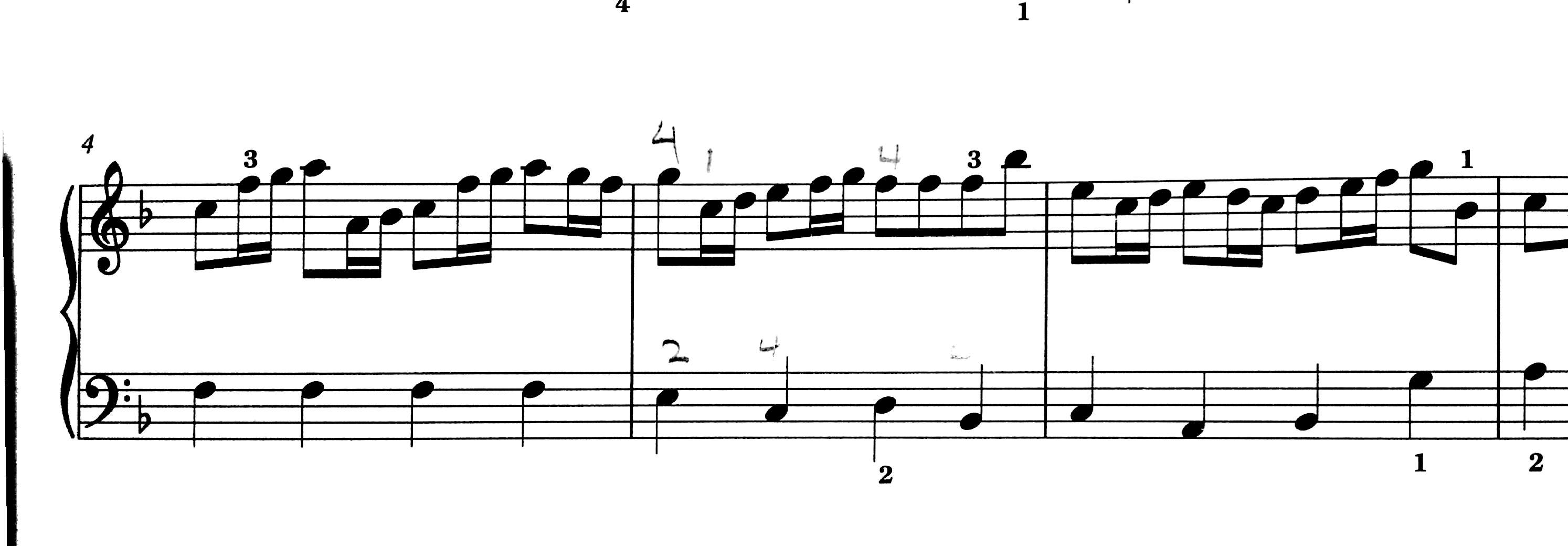
hop-scotch-pieces-in-f-major


They are meant to be a starting point; try adding some extra notes here and there to turn them into “hands together” pieces – a chance for your pupils to choose what notes they think would work, and write them in. They could also put in natural signs in front of some of the B flats and see if they like the effect.

holly

Posted in Piano, Sight Reading | Leave a comment

83/100 Discussion Groups

You know the scenario… you play a piece of music, and then ask questions about it. Three children put their hands up, and the others watch and wait.

the magic hand of silence

I noticed that in many primary school classes, the children are assigned “talking partners”. I’m not sure how that works in the classroom, but in my music lessons, I do it like this;

Before playing the recording, I tell them the sort of things that I would  like them to listen out for… for example

A song that I am going to teach them; What is it about? What sort of mood is it? Are the singers adults or children? How many people are singing? How is it accompanied?

A piece of orchestral music; What sort of mood is it? What makes it effective? What instruments/percussion can they hear? Is it being played by a few people or lots of people? Would you dance to it, march, use it for a backing track for a film? Does it have a tune? lots of tunes? no tune? Can you keep the beat or does it not seem to have a pulse? Does it stay the same speed?

A recording of a class performance; did everyone start together? was  everyone quiet at the beginning and the end? Did we achieve contrasts of dynamics/pitch/tempo/timbre, or whatever we were aiming for? if we were singing, could you hear the words? if there was an ostinato, was it neat, tidy and in time?

After we’ve listened to it, I put the children into threes, remind them of the questions, and let them talk about it in their little groups. A few minutes later, I ask them to choose a spokesperson, and agree on just one thing that they would like to share.

sssss

Once they are all ready, we go round listening to each spokesperson in turn. I make a point of explaining that I don’t mind if two groups want to say the same thing. I remember one very competitive boy desperately wanting his group to go first, in case another group was going to say “their comment”. The point is that two groups can share the same opinion but express it differently, or add an extra bit of information.

I’ve found that this way we have a proper sharing of information and discussion, making a good preparation for whatever the next step in the lesson will be.

holly divider

Posted in Class Teaching, The organised teacher | Tagged | Leave a comment

82/100 A New Way to be Scared – Handbells

Who would have thought that handbells could be so scary?

It all looks so easy…  here’s a “flashmob” in Hawaii which you can listen to on youtube: (it’s only three minutes long)

handbells-carol-flashmob

I love that resonant sound.

I used to ring in a Handbell Consort; we took it fairly seriously, but not to the extent of wearing white cotton gloves. OUr repertoire was extensive and impressive – “Star Wars”, “Light Cavalry Overture”, and even Scott Joplin Rags.

Today we had an ad-hoc all-age handbell session as one of the activities in church this morning. I made a very, very simple chord-based accompaniment to two of the hymns/songs that we were gong to sing later on. The grown-ups and the sensible small child soon got the hang of which bell to ring when, and how to ring correctly and safely. You hold the bell by the leather handle, as close as possible to the bell, and ring it away from you with a similar action to knocking a nail into a plank of wood.

Not so scary.

EXCEPT that if you have a small not-so-adept child, they stand a very good chance indeed of hitting themselves in the face as they bring the bell back up after “knocking in the nail”. The edge of the bell is quite sharp, and it’s mass and energy, even for a small bell, is considerable, so the injury you can inflict on your face will be substantial.

Here’s the mantra; “hold the bell up, like a cup of water. Tip forwards, to throw the water over the teacher, and bring it up again, without tipping the water back over yourself”. Small not-so-adept-children tend to prefer force to technique to try and make the bell sound, which is where we all get scared.

So I stood there, ringing my bells, and calling out “Fred’s turn, Joe’s turn, Fred-watch-your-bell-turn, both of you”. We got through all the verses without any bloodletting, I was glad to say. I think I will try and bring in some soft beaters for the smaller children to use next time.

Posted in Percussion | Tagged | Leave a comment

81/100 Christmas Samba

With my fairly experienced year 5 and 6 class, I’ve been working on rhythms where the words start on the “up-beat” all term, based on a “desktop” samba taken from “The Singing Schools books by Maurice Walsh. It had word-rhythms such as “See you in Rio, will I” which I allocated to agogo bells, and “Go to Brazil, I want to” which tamborims played. It took several lessons before this group could reliably get the right part of their word rhythm on beat 1, but once they could do that, they were away!

As a result of all that practice, this little samba took no time at all to put together. It is based on the old Christmas rhyme;

Christmas is coming

the Geese are getting fat

Please put a penny

in the Old Man’s hat

Notice how beat 1 falls on the high-lighted words. Teach it to the whole class, keeping a steady beat and explaining how the words fit to a 1 2 3 4 count.

Now allocate lines to instrumental sections. I did it like this;

line 1 tamborim

line 2 ganza

line 3 agogo – let them choose which words are high or low but don’t let it get too complicated

line 4 shared between repinique “in the” and surdo “Old man’s hat”

Now play it round the different sections in turn, until it is running smoothly.

Now to layer it up – I just told each section to repeat their line continuously once their turn arrived. Done. Christmas Samba!

holly divider

Posted in Samba | Tagged | Leave a comment