
http://www.lefthandedpiano.com/
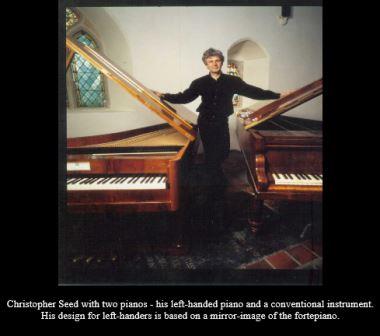
Oh.
Ah.
Read all about it here! http://news.bbc.co.uk/1/hi/uk/178608.stm
I’m still not going to let them play their ukuleles or recorders with the “wrong” hands!

http://www.lefthandedpiano.com/
Oh.
Ah.
Read all about it here! http://news.bbc.co.uk/1/hi/uk/178608.stm
I’m still not going to let them play their ukuleles or recorders with the “wrong” hands!
I am teaching cyclic patterns this term with a Year 5 and 6 class. We have got the Music Express books at this school, and they have a music clip of stamping tubes played in the Solomon islands (link to Geography – where on earth are the Solomon Islands!)
The first time I taught this unit, boomwhackers, or whackatubes, as they seemed to be called now, had barely made it into the music catalogues. I used the cardboard tubes from inside wrapping paper, and played them by tapping the open end with drinks coasters. They did not last for many lessons with the particular crowd of children I was teaching at that time, I have to say. The tubes, I mean. The coasters are still going strong, and the children are no longer at any school, except maybe as teachers.
Here is what stamping tubes look and sound like:http://www.youtube.com/watch?v=4BgNRkNpGyg

I love the sound – and I amazed at his skill.
The class listened to the clip supplied in the Music Express year 6 book. It took several attempts – at first they were keen to jiggle and fidget about, and although they were clearly enjoying the music, they weren’t actually “listening” to it. So I let them “express themselves” and then we listened again, sitting still and not giggling.
We picked out features of the music – cyclic patterns, obviously, but also changes in texture, rhythm and pitch. Then I set them the task of re-creating the effect, in groups of 4, using a boomwhackers (one each). It was the most enjoyable lesson I have taught all term – well, to be truthful, it was the first lesson of term. My role seemed to reduce to going round the groups and asking if they were organised and knew what they were doing “”yes, yes, we’re all sorted”). I got the feeling that my questioning was seen as a bit of an irritating interruption to what they were doing.
After about ten minutes I could stand the noise no more, so we listened to each group in turn. Amazing! They had all picked up on the requirement to create cyclic patterns involving pitch, texture and rhythm. I encouraged them to comment on each other’s work, and to pick up ideas from what they heard. There was still a good chunk of lesson to go, so I gave them another block of time to develop and improve their work. This time I knew my place, and just stood and watched the scene and sounds of activity all around.
When we listened to their work again, they had all added features – dynamics, additional rhythmic patterns, changes to texture.
I went home from that lesson very happy indeed!
Easter holidays – and somehow this edition of the Jungle has become so late that it is really next week’s issue. However it is full of goodies: some ideas for crowd control that have worked for me, a fantastic new djembe rhythm from Ianto Thornber, and a little foray into the world of the Eastern Orthodox Church.

I’ve tried a number of ways of gaining the attention of a class of children who are all otherwise engaged. These techniques have all worked, in the various teaching environments that I find myself.
The main tactic is to try and remove energy (or noise) from the teaching space, rather than adding to it. I save my really, really, loud, shouty voice for exceptional occasions – probably only once every other year. It is also very important to have clear and consistent signals for silence.
The signals I tend to use are:
I raise my hand, everyone raises their hand AND stops talking/playing as soon as they notice what is going on. Anyone caught still playing their instrument with the other hand has their beater/instrument temporarily removed. This signal works well when the children are scattered around the space working individually or in groups.
I hold my hand out, balled into a closed shape (sounds so much gentler than saying “make a fist”!). I use this when we are all sitting in a circle, for example in djembe lessons, or class music lessons.
Many class teachers clap a rhythm, and all the children join in and look at the teacher. They usually use the “Don’t clap this-one-back” pattern, which can cause confusion when you then teach them the game, so I tend not to use this method in music. Besides it is noisy and I’m after silence!
Here are a few other situations
Situation 1: Children seated, facing a whiteboard which I am using to teach from. They could be sitting on the carpet, or at tables arranged in groups or a horse-shoe shape. There is a constant tendency to chat, and fidget. This situation is most likely when it is the last lesson of the afternoon, especially last lesson of Friday afternoon!
Response: I stop in mid-sentence and slump against the whiteboard, close my eyes and pretend to have gone to sleep. The chatter stops, and the children start shushing each other and telling each other “Shh, she’s gone to sleep again” (you can tell that they are getting used to me). Once it is quiet, I “come to” and continue where I left off as though nothing had happened.
Situation 2: Children seated as above, but where I don’t have a whiteboard or easel or wall to slump against
Response: I ostentatiously bare my wrist watch in front of me and stare at it, ignoring the children. Once I have their attention, I tell them how long I have been looking at the time. Usually they get the hint; the next time I start staring at my watch, they try and “beat” the time it took previously. If possible, I make a point of writing down how long they took somewhere obvious.
Situation 3: Children need on-going reinforcement to develop the habit of paying attention.
Response: I plan some kind of reward, for example a favourite game or song. I promise that we will do this reward activity at the end of the lesson, and the length of time we do it for depends on number of “marbles in the jar” at the end of the lesson. The “marbles” can be any appealing visual signal; eg blu-tac large stars to the wall, draw a jar and marbles on the whiteboard. It is up to you whether “marbles” can be removed as well as added. You MUST keep your promise! If there aren’t many marbles in the jar by the end of the lesson, they may just get to sing just the first verse – this week! See if you can do better next week!
Situation 4: – Working “with” the class
I explain that there are a number of things that I “need” to get done n the lesson, and once we have done what’s on my list, we can finish with – a favourite game, song, activity. Then, if they start getting distracted, I remind them that they are at risk of not getting through the things on my list before the end of the lesson, and missing out on the reward activity. It is similar to the last idea, but without the visual reminder.
Well – good luck for this coming term!
I needed a replacement tamborim head, and contacted http://www.knockonwood.co.uk/. It was a bit of a random choice – I just searched the internet and chose this one as the most likely supplier to come up with what I wanted. So, I telephoned to discuss tamborims and fund myself talking to Ianto Thornber, author of my main source for djembe teaching, “The Djembe Guide”. That was a bit of a Wow!

picture copied from amazon website
He was able to source what I needed, and was very helpful, reasonably priced, and super-efficient. He also sent me a djembe rhythm, inspired by Hurricane Sandy, and permission to share it here on The Music Jungle. Thanks, Ianto!
Here’s his introduction to the piece:
Hi
If you like jabba jabba djembe you might also like this “wot” I wrote myself during Hurricane Sandy
It’s very easy with one part going, gets better with 2, and pretty wild with 3.
The parts are all the same, apart from the start point/phase shifting
It goes down well with lots of rattly shekere shakers to sound like rain, and you can have lots of storm related fun with the intensity going up and down.
It’s also a 6/8 but feels really easy.
cheers
and here’s the rhythm:

I played a Hildegard von Bingen track from Heavenly Revelations with a year 1 and 2 class at the end of last term. It was a bit of a random choice – it just happened to be the track that I had just been listening to on my mp3 player, and I wanted something for the children to listen to as they settled down after playtime. What caught my attention this time (apart from the magical stillness that came over the children as they sat waiting for the “real” lesson to begin!) was the lower voice, singing just a series of drones.

I hadn’t come across this type of singing before, and was ntruiged, but the moment passed, and the next events of the day (more teaching, more activity, more errands, more administration) just buried that moment of curiosity.
Later, I was following up a reference to “Spy Wednesday” in relation to the week before Easter Sunday. The Wikipedia entry took me by stages to these wonderful, wonderful videos of an ancient Byzantine Eastern Orthodox hymn written in the 9th century by St Kassia.
In the youtube clips that follow, you can hear the second voice singing the drones that form the accompaniment for the beautiful, flowing melodies. The third link takes you to the sheet music for the second version of the song.

Russian icon of St Kassia holding a scroll
with her hymn written on it.
http://en.wikipedia.org/wiki/Holy_Wednesday
I browsed through the information on the www.newbyz.org website. This is a whole new world of music and liturgy of mind-bending complexity. I’ll have to save it for when I have several years to begin to study it properly.
I had a little holiday from the Jungle over Easter, but I’m back again! I listened to all kinds of weird and wonderful music (thank you, youtube) and here’s a selection: unlikely versions of “in a Persian Market” and “Also sprach Zarathustra“.
Also some thoughts on music exams…
have a good week,
Every so often, I put myself in the position of my pupils; I take a music exam.
Unnecessarily?
It started when I took my LTCL as an adult, after I had been working in the computer industry for many years. I was faced with redundancy, and needed to find a way of earning while fitting in around the children. As I had continued to play the piano after leaving university, and even had lessons from time to time, this seemed like a good idea. My word, that practical exam was one of the scariest experiences ever. Still, in spite of running out of keyboard in one scale, and miscalculating the number of octaves in a chromatic scale, and starting the Bartok on entirely the wrong notes, somehow I passed.
Then, I found myself in charge of a church choir and ignorant of the principles of singing, and so I took singing lessons, culminating in a Grade 5 exam (distinction, let me gloat for a moment). Singing exams are a whole new world of scary – no music stand or music to hide behind!
Then the ABRSM Jazz piano syllabus came out. This was a whole new world for me – improvisation just hadn’t been invented as far as my music lessons were concerned – at school, on cello, on piano. Remember, this is back in the dark ages when I have a feeling saxophones were not admitted to music colleges! So, as three of my students were taking grade 2 and 3 in jazz piano, I took a grade 4 ( and I passed) just so that I could find out about how the exams worked, and relate the marking to the actual exam experience.
A few years later, I took a Grade 1 violin exam. (Merit. I had hoped for greater things!)
Why? Well, I found that personally revisiting the exam experience was extremely useful in preparing my pupils for their exams. The way the examiners interact with the candidates is different to how it was back in the 70s. They are less formal, (but still scary!). It was good to see how the aural and sight-reading tests are presented to the candidates. And I hadn’t expected to be so nervous; Grade 1 aural tests – simple, surely? Well, if you lose concentration and focus, you lose marks. So I lost a mark. Me! Moi! only 17 out of 18 for aural! And I really, really hadn’t expected my bow to bounce as much on the strings. That exam was also an interesting learning curve for one of my piano pupils who accompanied me, but that’s another story.
What’s next? I had been working for a Trinity Guildhall saxophone exam, but what with one thing and another I ran out of time last term. Now I am preparing a student for grade 8 piano, and would have liked a trial run with Trinity, as I have always “done” ABRSM until now. Oh well. Luckily she has taken Trinity exams before on violin so at least she knows what to expect.