Issue 83: In a Persian Market?

Many years ago I used to play in a handbell consort. Indeed, it was a rather top-notch handbell consort. We played “off the table” rather than “in hand”, which meant that we each had an array of up to about fifteen bells set out on a padded surface in front of us, which we would snatch up and ring at PRECISELY the right millisecond in order to perform complex arrangements. There were about a dozen of us, as I remember. I tended to have the bells for – I’m half guessing here – E flat, E, F, F sharp and G in three different octaves, ranging in size from a small mug to an espresso coffee cup.

One of our tougher pieces was an arrangement of Ketelbey’s “In a Persian Market”.
Product Details

The Persian Market turns up in many unlikely guises;

I suppose this 1920’s theatre organ music roll recording is the least surprising:

http://www.youtube.com/watch?v=L73jE6pKEFg

Here is a version performed by a Japanese Spanish Guitar Orchestra:

http://www.youtube.com/watch?v=GMbiLa0KCjs

James Last and His Orchestra had a go: http://www.youtube.com/watch?v=KuUQa2C8x1c

This version, by a Double Bass Orchestra, in full costume, complete with gigantic gong, has to be my all-time favourite (after our own handbells, of course)

http://www.youtube.com/watch?v=GMbiLa0KCjs double bass

After all this, I have no idea what Ketelbey actually intended!

Posted in The Jungle | Tagged , | Leave a comment

Issue 83: Portsmouth Sinfonia

I thought this was a huge joke when it first came to my attention: http://www.youtube.com/watch?v=hpJ6anurfuw

Product Details

a youtube video of what happens when everyone swaps to an instrument that they can’t actually play. Laugh? I howled!

But it seems there is more to it than I thought. Oh no, another fake? Or maybe not.

Here’s an extract from Wikipedia; http://en.wikipedia.org/wiki/Portsmouth_Sinfonia

The Portsmouth Sinfonia was an orchestra founded by a group of students at the Portsmouth School of Art in England, in 1970. The Sinfonia had an unusual entrance requirement, in that players had to either be non-musicians, or if a musician, play an instrument that was entirely new to them.[ Among the founding members was one of their teachers, English composer Gavin Bryars. The orchestra started as a one-off, tongue-in-cheek performance art ensemble but became a cultural phenomenon over the following ten years, with concerts, record albums, a film and a hit single. They last performed publicly in 1979.

Bryars was interested more in experimenting with the nature of music than forming a traditional orchestra. Instead of picking the most competent musicians he could find, he encouraged anyone to join, regardless of talent, ability and experience. The only rules were that everyone had to come for rehearsals and that people should try their best to get it right and not intentionally try to play badly.

And a link to a Sunday Times article on the Portmouth Sinfonia’s own website

http://www.portsmouthsinfonia.com/media/sundaytimes.html

here are the opening paragraphs…

THE SUNDAY TIMES (UK) Sunday May 30th 2004

THE REAL GODFATHERS OF PUNK

Thirty-four years ago, a musician taught his band not to play. It led to anarchy in the UK, says Dan Cairns

Those people who say that British punk was born during the Sex Pistols’ debut gig at St Martin’s School of Art in central London on a November night in 1975 may need to think again. For there is a serious case to be made for its birth having occurred five years earlier in Hampshire. In May 1970, the composer Gavin Bryars, then a lecturer at Portsmouth College of Art, entered a talent competition entitled Opportunity Rocks with a scratch band he’d assembled for the occasion. Purely as a joke, and planning it as a one-off, he called the group the Portsmouth Sinfonia.

Well, I leave you to make up your own mind…


Posted in The Jungle | Tagged | Leave a comment

Issue 82: Welcome to the Jungle

Well, hi there everyone!

It’s been a bit of a packed week last week, and this weekend was pretty full on too, so I’ve got just the two posts for you this week.

Last week was the usual teaching round, plus an afternoon of accompanying yet more music exams. To my delight, the little violinists managed to play quite a few dotted minims along the way in Daisy Bell, and remarkably well in tune too. As usual, under exam pressure, usually reliable students tended to become a little wayward, so the Poulenc flute sonata (second movement) had rather more changes of time signature than are written in the score, but by and large we stuck together pretty well. It sounded good – if one wasn’t very familiar with this movement, one might not be too conscious of the difference between our version and Poulenc’s.

On Saturday I was part of a team leading a keystage 2 music enrichment day on Improvisation. We had the most delightful group of children, who behaved impeccably, worked hard, and were all confident on their flutes, cornets, violins, cellos, keyboards and recorders. Once child arrived with a djembe, and another with a full drum kit! At the end-of-day concert we performed three pieces, based on rhythm cards, the 12-bar blues, and Pachelbel’s Canon. I shall write these up in due course.

So, this week I am bringing you an account of a ukulele and recorder lesson using “Hot Cross Buns“, and information about the Pace-Egging tradition and a source for the associated song and play.


Posted in The Jungle | Leave a comment

Issue 82: Hot Cross Buns

This was the perfect seasonal vehicle for my year 3 ukulele and recorder class. So far we have concentrated on the notes C B A G on the recorder and our current project on ukuleles is getting to grips with G major.

First of all I taught the whole song by rote. Most children knew it anyway.

“Hot Cross Buns, Hot Cross Buns, One-a-penny, Two-a-penny, Hot Cross Buns”

Once we had learned it (didn’t take long!), I wrote the first line on the whiteboard:

The children called out the letters (B A G), called out the fingering ( 1 2 3), and we were away. We fitted this first line into the song; they played the first, second and fourth lines, and I supplied the missing line.


The next step was to work out the missing line. The rhythm posed no problem, but finding the right notes stumped most of them. I had to be a bit quick to persuade the flute players not to give the game away, as they had already learned the whole of “Hot Cross Buns” in their flute lesson last week! I played the suggestions for the first note, and we agreed that it wasn’t A or B. Aha! It’s a G!

I wrote up the missing line, and then changed the words slightly, and asked them why I thought it would be easier if we sang “three” instead of “one”. A bright spark obligingly made the connection with the new words and the fingering, and we were now able to play the whole song.

Switching over to ukuleles, we just played chord G in time with the pulse. It doesn’t fit properly with the third line, but we didn’t let that stop us from having a good time.

The only little hiccup was dealing with the creative input from a couple of lads in the back row. I thought “Hot Cross Mums” was quite amusing, but took action when they moved on to changing the first “M” for a “B”…

Posted in Recorders, Songs, Ukulele | Tagged , , | Leave a comment

Issue 82: The Pace Egging Song

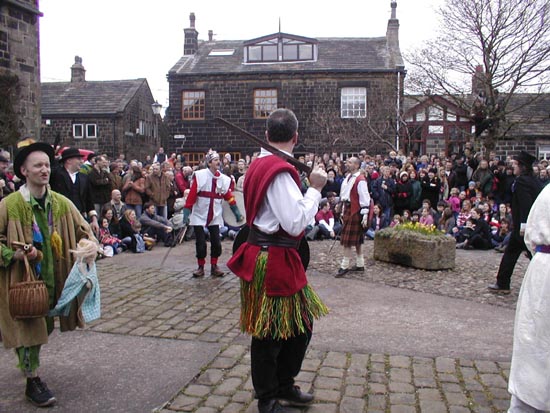
Pace Egging

Pace Egging is an old Easter tradition in Northern England, where local villagers, known as “the Jolly Boys” would dress up in disguises and act out a play, very much in the style of the “Mummers”, which I’ve always  associate with Christmas time. “Pace” comes from “Pacha”, the Latin word for Easter. I’ve gleaned the information from John Ravenscroft’s website here: http://www.timetravel-britain.com/articles/history/pace-egging.shtml

where you will find full details and more photographs.

You can get the words and the melody for the song here:

http://www.traditionalmusic.co.uk/song-midis/Pace_Egging_Song.htm

I have also managed to find several scripts for the play here:

http://www.folkplay.info/index.htm

The script at http://www.folkplay.info/Texts/89sd39ch.htm dates back over a hundred years! The Pace-Egging song is sung at the end of the play, no doubt when they were passing the hat round the crowd.


Posted in The Jungle | Tagged , , , | Leave a comment

Issue 81: Welcome to the Jungle

Welcome – the weekend has nearly ended and next week is nearly here. To my amazement, I have managed to get issue 81 of the Music Jungle posted inspite of every impediment and distraction that has filled the weekend – teaching, writing up lessons from last week, planning lessons for the coming week, playing for saxophone exams (my word, Faure’s “Apres un Reve” makes a b-e-a-u-t-i-f-u-l saxophone solo – totally fabulous, especially the way she played it yesterday!), shopping, more shopping, playing organ and piano for the early church service, taking one of the Sunday school groups for the second service – – – – the weekend seemed to be jammed packed with one activity after another.

However, reading on, you will discover my main resource for last week’s warm-ups, an idea for next week’s warmups and activities, and my secret for falling asleep.

Have a good week.

Posted in The Jungle | Leave a comment

Issue 81: www.singforpleasure.org.uk

Years and years ago I bought a set of songbooks from “Sing for Pleasure”. Their website is here:  http://www.singforpleasure.org.uk/ and you can buy the booklets individually from a few pounds each. The investment was Well Worth the Money!

Product DetailsAlthough there is a mention of an accompanying CD on the website, I haven’t been able to track it down. Ah well, that’s probably why the little A5 booklets are so very reasonably priced.

I’ve been singing “Kumala Vista” from this little yellow booklet all week; for £2.95, you can sing it too!


Posted in Resources, Songs, Uncategorized | Tagged , , | Leave a comment

Issue 81: Rainy Day Song

I found a great little song on this blog:

http://www.meyersmusicactivities.blogspot.co.uk/2011/01/this-elementary-choral-arrangements-for.html


Don’t just stop here – go to the blog and discover the dance/game, sung ostinato, and composition activities in the original post. Brilliant! Guess what I’m going to be doing all this week!

Posted in Composition, Songs | Tagged , , , | Leave a comment